
A 5E lesson plan is an effective teaching method that many homeschool parents are not familiar with. If you’re finding it hard to make your lessons more engaging, organized, and effective, this model can completely change the way you teach at home.
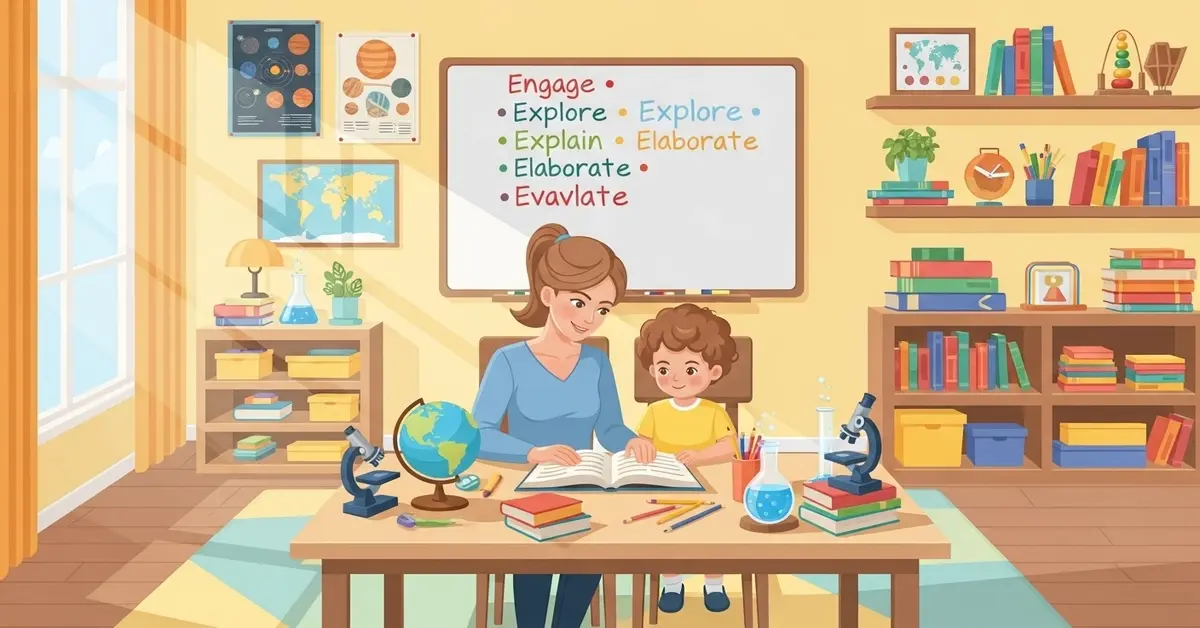
The 5E model-Engage, Explore, Explain, Elaborate, and Evaluate-was originally developed by science educators but is effective across all subjects. In this guide, you will learn what a 5E lesson plan is, how to create one step by step, and how AI tools can streamline and enhance the entire process. If you are now starting with AI-powered homeschooling, be sure to check out our complete guide to AI tools for beginners first.
Key Takeaways
- ✅ The 5E lesson plan has 5 stages: Engage, Explore, Explain, Elaborate, Evaluate
- ✅ It works exceptionally well for homeschooling because it follows how children naturally learn
- ✅ AI tools like Claude can generate complete 5E lesson plans in minutes
- ✅ You can use a free Google Docs template to get started immediately
- ✅ The 5E model improves retention, curiosity, and critical thinking in kids of all ages
What Is a 5E Lesson Plan? (And Why It Works So Well)
The 5E lesson plan is an inquiry-based instructional model developed by Roger Bybee and the Biological Sciences Curriculum Study (BSCS) in 1987. It was originally designed for science education, but today it is used across every subject — from math and history to language arts and life skills.
Unlike traditional lessons, where the teacher mainly lectures and students memorize, the 5E model puts the child at the center of learning. Each stage is designed to spark curiosity, build understanding step by step, and ensure that real learning has happened.
For homeschooling parents, this is a game-changer. You are not just covering material — you are helping your child think, discover, and apply knowledge in meaningful ways. According to the National Science Teaching Association, the 5E model significantly increases student understanding and retention compared to direct instruction alone.

The 5 Stages of a 5E Lesson Plan Explained
Let’s break down each stage clearly so you can start applying it in your homeschool right away.
Stage 1: Engage — Spark the Curiosity
The Engage phase is where you hook your child’s attention. This could be a surprising question, a short video, a hands-on demonstration, or a real-world problem. The goal is to activate prior knowledge and get your child genuinely curious about what they are about to learn.
Example: Before a lesson on the water cycle, show your child a glass of cold water “sweating” on a warm day and ask, “Where is that water coming from?”
Stage 2: Explore — Let Them Discover
During the Explore phase, your child investigates the topic with minimal guidance from you. This might mean conducting a simple experiment, reading a passage and taking notes, watching a documentary, or doing hands-on activities. The key is that they are doing the discovering.
If you want structured activity ideas for this phase, check out our guide on project-based learning for homeschoolers — it pairs perfectly with the 5E explore stage.
Stage 3: Explain — Build the Understanding
Now it’s your turn to step in. The Explain phase is where you introduce vocabulary, concepts, and formal explanations — but always connecting back to what your child just discovered. Ask them to share what they found before you explain. This activates a deeper understanding.
AI Tip: Use an AI tool to generate age-appropriate explanations of any concept. Simply prompt: “Explain [topic] to a 9-year-old in simple language.” You will get a clear, tailored explanation in seconds.
Stage 4: Elaborate — Apply and Extend
The Elaborate phase challenges your child to use what they have learned in a new context. This could be a creative project, a written response, a presentation, or connecting the concept to another subject. This stage builds critical thinking and knowledge transfer.
Want ideas for cross-subject elaboration? Our post on using AI tools for homeschooling has some creative project prompts you can use immediately.
Stage 5: Evaluate — Confirm the Learning
The Evaluate phase is ongoing throughout the lesson, not just at the end. Use formative assessments like questions, observations, and exit tickets to check understanding. At the end, a quiz, written summary, or oral presentation can serve as a summative assessment.
According to Edutopia’s research on the 5E model, consistent evaluation throughout a lesson (not just at the end) leads to significantly better learning outcomes for children.

How to Create a 5E Lesson Plan Using AI (Step by Step)
This is where the AI Homeschooler approach truly shines. AI tools can generate a complete, customized 5E lesson plan for any subject and any age group in under two minutes. Here is exactly how to do it.
- Choose your subject and topic — for example, “Fractions for Grade 4” or “The American Revolution for Grade 7.”
- Open an AI tool (Claude, ChatGPT, or Gemini work well)
- Use this prompt: “Create a 5E lesson plan for a homeschool child in Grade [X] on the topic of [TOPIC]. Include Engage, Explore, Explain, Elaborate, and Evaluate sections with specific activities, time estimates, and materials needed.”
- Review and customize the output for your child’s learning style and pace
- Save it in Google Docs using a free 5E lesson plan template (link below)
For a deeper walkthrough of using AI to plan your entire homeschool curriculum, visit our post on AI-powered homeschool curriculum planning.
Free 5E Lesson Plan Template for Homeschoolers
Here is a simple template you can copy directly into Google Docs or print out. Fill in each section as you plan your lesson.
| Stage | Activity / Description | Time | Materials |
|---|---|---|---|
| Engage | Hook activity, question, or demo to spark curiosity | 5–10 min | Video, object, or question |
| Explore | Hands-on or independent investigation activity | 15–20 min | Books, experiment kit, worksheet |
| Explain | Direct teaching, vocabulary introduction, discussion | 10–15 min | Notes, textbook, AI-generated explanation |
| Elaborate | Creative project, writing, cross-subject application | 15–25 min | Art supplies, writing materials, computer |
| Evaluate | Quiz, oral Q&A, exit ticket, or written summary | 5–10 min | Quiz sheet or notebook |
5E Lesson Plan Examples for Different Subjects
Let’s look at quick 5E lesson plan examples across three different subjects to show how flexible this model really is.
5E Science Lesson Plan Example: Water Cycle (Grade 3–5)
- Engage: Show a boiling kettle and ask where the steam goes
- Explore: Watch a short documentary clip on the water cycle; draw what they see
- Explain: Introduce terms: evaporation, condensation, precipitation, collection
- Elaborate: Create a mini water cycle in a zip-lock bag taped to a sunny window
- Evaluate: Label a blank water cycle diagram from memory
5E Math Lesson Plan Example: Fractions (Grade 4–6)
- Engage: Share a pizza and ask, “If we cut this into 8 pieces and you eat 3, what fraction did you eat?”
- Explore: Use fraction tiles or draw fraction bars to compare sizes
- Explain: Teach numerator, denominator, equivalent fractions with visual models
- Elaborate: Have them create a “fraction recipe” by doubling a real recipe
- Evaluate: Solve 5 fraction problems; explain reasoning for one answer
5E History Lesson Plan Example: American Revolution (Grade 6–8)
- Engage: Ask: “Have you ever felt a rule was unfair? What did you do about it?”
- Explore: Read primary source excerpts from the Declaration of Independence
- Explain: Discuss causes of the Revolution: taxation, representation, colonial frustration
- Elaborate: Write a “letter to King George” from a colonist’s perspective
- Evaluate: Oral presentation: “Was the Revolution justified? Give 3 reasons.”
Frequently Asked Questions About 5E Lesson Plans
Q: What does 5E stand for in a lesson plan?
A: The 5E stands for the five stages of the instructional model: Engage, Explore, Explain, Elaborate, and Evaluate. Each stage builds on the previous one to create a complete, inquiry-based learning experience for students of any age.
Q: Is the 5E lesson plan only for science subjects?
A: No — while the 5E model was originally developed for science education, it works beautifully across all subjects, including math, language arts, history, social studies, and even life skills. Any topic that benefits from inquiry and critical thinking is a good fit for the 5E approach.
Q: How long does a 5E lesson plan take to complete?
A: A typical 5E lesson takes between 45 and 90 minutes, depending on the age of the child and the complexity of the topic. For younger children (K–2), you can compress each phase to 5–10 minutes. Older students (Grade 5+) benefit from longer Explore and Elaborate phases of 20–30 minutes each.
Q: Can I use AI to generate a 5E lesson plan for homeschooling?
A: Absolutely — and it is one of the best uses of AI for homeschooling parents. Tools like Claude or ChatGPT can generate a fully detailed 5E lesson plan for any subject, grade level, and learning style in under two minutes. Easy to describe your child’s grade, the topic, and any special learning needs, and the AI will produce a complete, ready-to-use plan.
Q: What is the difference between a 5E and a traditional lesson plan?
A: A traditional lesson plan follows a straight path: the teacher explains, students practice, and then take a test. The 5E lesson plan, however, takes a different approach. It encourages children to ask questions, explore ideas, and discover answers on their own. Instead of just listening, they stay active and fully involved in the learning process. Research shows that this approach helps students remember concepts better and develop a deeper understanding.
Q: Is there a free 5E lesson plan template I can download?
A: Yes! The table template provided in this article is free to copy and use. You can paste it directly into Google Docs, format it to your preference, and reuse it for every lesson. Many homeschooling communities also share 5E templates on Teachers Pay Teachers and education.com for specific subjects.
Conclusion: Start Using the 5E Lesson Plan in Your Homeschool Today
The 5E lesson plan is more than just a teaching framework — it is a philosophy that puts your child’s curiosity and discovery at the heart of every lesson. When combined with AI tools, it becomes an incredibly powerful system that saves you hours of planning time while delivering richer, more meaningful learning experiences.
Start with one subject this week. Choose a topic, use the template from this guide, and try all five stages. You will be amazed at how much more engaged your child becomes — and how much more confident you feel as a homeschooling parent.
Ready to take your homeschooling further? Read our complete guide on the best AI tools for homeschooling in 2026 and discover how to automate your lesson planning, track progress, and personalize learning for your child’s unique strengths.
Have questions or want to share how you use the 5E model in your homeschool? Drop a comment below — we would love to hear from you!