Stop Using AI Homework Helpers for Kids Until You Read This
Picture this. It is 8:00 PM on a Tuesday. Your child is crying at the kitchen table over a really hard math worksheet. You are tired from a long day at work. You look at the math problem and realize you have no idea how to solve it. It looks like a foreign language. Then, you remember hearing about an AI homework helper for kids. You think, “Perfect! I will just have the computer do it.”
Wait! Stop right there.
Before you hand over your phone or tablet to let a smart robot finish your child’s math sheet, you need to read this. AI is completely changing how kids learn. But if you use it the wrong way, it can actually hurt your child’s brain power. In this guide, you will learn the hidden dangers of AI, how to find the safest tools, and how to set rules so your child actually learns instead of just copying.
An AI homework helper for kids is a smart computer program that helps students with their schoolwork. It can answer questions, explain hard math problems, and fix spelling mistakes. However, kids should use it like a friendly tutor to learn new things, not as a tool to cheat and just get the quick answers.
What Is an AI Homework Helper for Kids?
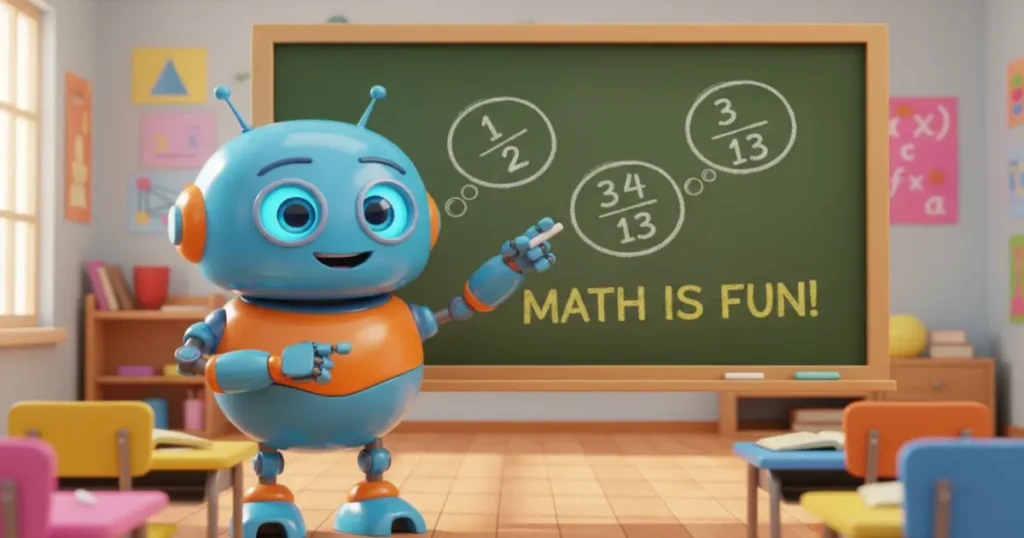
Let’s start from the very beginning. What exactly are we talking about when we say “AI”? AI stands for Artificial Intelligence. Think of it like a very fast, very smart brain that lives inside your computer. When you type a question into an AI, it reads millions of books and websites in a single second to type an answer back to you.
An AI homework helper for kids is a special kind of AI. It is designed to look at a student’s homework and help them figure it out. Some of these tools let you take a picture of a math problem with your phone camera. A few seconds later, the app shows you exactly how to solve it.
Other tools are like chat rooms. Your child can type, “I don’t understand how fractions work. Can you explain them to me like I am ten years old?” The computer will then type back a simple, fun story about slicing up a pizza to explain fractions.
It sounds like magic, right? It is like having a private teacher who lives in your house and never goes to sleep. But just like any powerful tool, it has a right way to be used and a wrong way to be used. If you give a kid a calculator before they learn how to add, they will never learn how to do math in their own head. AI is the exact same way. We have to be careful.
The Good Stuff: Why Free AI Homework Help Sounds Great
Let’s be fair. There are many amazing reasons why parents and students are excited about this new technology. Finding good, free AI homework help can feel like a total lifesaver for busy families. Here are a few reasons why people love it so much:
- It is always awake: Real teachers have to sleep. Tutors go home. But an AI is awake 24 hours a day, 7 days a week. If your child remembers a huge science project at 10:00 PM on a Sunday, the AI is ready to help them brainstorm ideas.
- It never gets mad: Sometimes, kids are afraid to ask their human teacher to repeat a lesson. They don’t want to look silly. An AI never gets annoyed. Your child can ask the AI to explain the same history lesson twenty times, and the AI will happily do it.
- It saves parents time and stress: Let’s face it, school has changed since we were kids. The way they teach math today is totally different. Instead of parents feeling bad that they cannot help their kids, they can use the AI as a bridge. Parents can ask the AI, “How do they teach division in 4th grade now?” and learn right alongside their kids.
- It levels the playing field: Private tutors cost a lot of money. Not every family can afford to pay someone fifty dollars an hour to help their child study. Free tools give every kid a chance to have a smart helper, no matter how much money their family makes.
These benefits are huge. When families learn about homeschooling with AI, they see how much faster kids can grasp tough subjects. But these benefits only work if the child is actually doing the thinking.
As a parent/teacher, I know how hard it is to create engaging reading worksheets. That’s exactly why I built this AI tool – to save your time and effort. Try it Today
The Hidden Danger: Is Your Child Actually Learning?
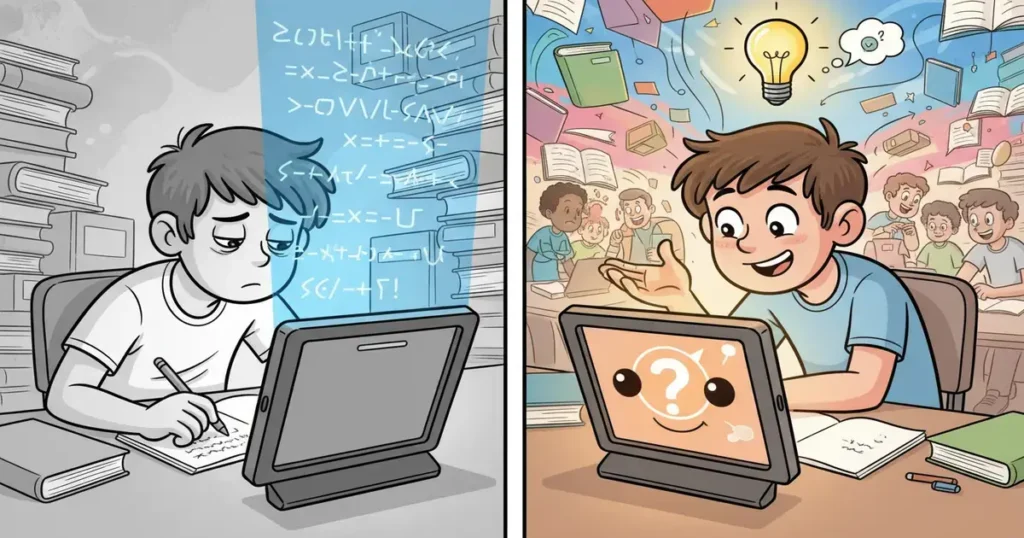
Now we get to the scary part. This is the reason I told you to stop and read this article. The biggest problem with AI is that it is too good at giving answers.
Imagine your child’s brain is like a muscle. If you want strong muscles, you have to lift heavy weights. It is hard work. You sweat, you get tired, but you get stronger. Learning is the exact same thing. When your child struggles with a hard homework problem, their brain is lifting weights. The struggle is the part where the learning actually happens.
If your child points an app at their homework and the app just writes down “x = 4”, the brain did zero work. The AI lifted the weight. The child’s brain did not grow at all.
Here are the biggest hidden dangers you need to watch out for:
1. Cheating Without Knowing It
Many kids do not even realize they are cheating. They think, “The teacher told me to get the right answer. The computer gave me the right answer. I am done!” But the teacher does not care about the answer. The teacher cares about the journey to get the answer. If a child uses AI to write an essay for them, they are skipping the chance to learn how to spell, how to build a sentence, and how to express their own feelings.
2. The AI Can Lie (Hallucinations)
Did you know that computers can lie? In the AI world, we call this a “hallucination.” Sometimes, if the AI does not know the real answer, it will just make one up. It will sound very confident. It will use big words. But it will be completely wrong. If your child trusts the AI blindly, they might hand in a history report about a war that never even happened!
3. Losing Confidence
If a child always uses a machine to solve their problems, they start to think they are not smart enough to do it themselves. They lose their self-confidence. When test day comes, and they are not allowed to use a computer, they will panic because they never learned how to trust their own brain.
How to Find the Best AI for Kids Homework
So, how do we fix this? We do not need to throw our computers in the trash. We just need to pick the right tools. If you want to find the best AI for kids homework, you cannot just use the first website you see. You need an AI that acts like a real teacher, not an answer key.
When you are looking for a good program, ask yourself these simple questions:
- Does it give the answer, or does it give hints? The best tools will refuse to give the final answer. Instead, they will say, “Let’s look at step one together. What do you think you should do first?” This forces the child to think.
- Is it safe for kids? Regular AI tools are made for adults. They might show kids links to bad websites or use words that are too hard to read. Look for tools made specifically for schools. A great example of this is Khanmigo by Khan Academy, which is built by real teachers to keep kids safe and focused.
- Does it protect your privacy? You do not want a random computer company saving your child’s name, age, and location. Always check the safety rules. You can use websites like Common Sense Media to see if an app is safe for your family.
If you pick a safe tool that forces your child to think, AI becomes a superpower instead of a cheating machine. This is a big part of creating a great AI learning environment at home.
Smart Prompts: How to Talk to an AI Homework Assistant for Students
Even if you find a great tool, your child needs to know how to talk to it. In the computer world, the words you type to the AI are called a “prompt.” Writing a good prompt is a very important skill.
If an AI homework assistant for students is going to help, the student must tell it to be a teacher. Here is a list of good prompts and bad prompts to show you the difference.
The Bad Prompt:
“Write a 500-word essay about George Washington.”
Why it is bad: The AI does all the work. The child learns nothing.
The Good Prompt:
“I need to write an essay about George Washington. Can you give me three interesting facts about him that I can use to start my outline? Do not write the essay for me.”
Why it is good: The AI acts as a helper. The child still has to write the essay.
The Bad Prompt:
“What is 8 times 7?”
Why it is bad: It just gives the answer. You could just use a calculator for this.
The Good Prompt:
“I keep forgetting what 8 times 7 is. Can you teach me a fun trick or a song to help me remember my 8 times tables?”
Why it is good: The AI teaches a skill that the child can keep in their brain forever.
Teach your kids to use the magic words: “Do not give me the answer.” If they type that into the AI every time, they are on the right track.
Setting the Rules: How to Keep It Safe

You are the parent. You are the boss. The AI is just a tool in your house, like a microwave or a television. You get to make the rules. Before you let your child use an AI homework helper for kids, you should sit down and make a family contract.
Here are some simple rules you can use in your house:
Rule 1: Use it in the open.
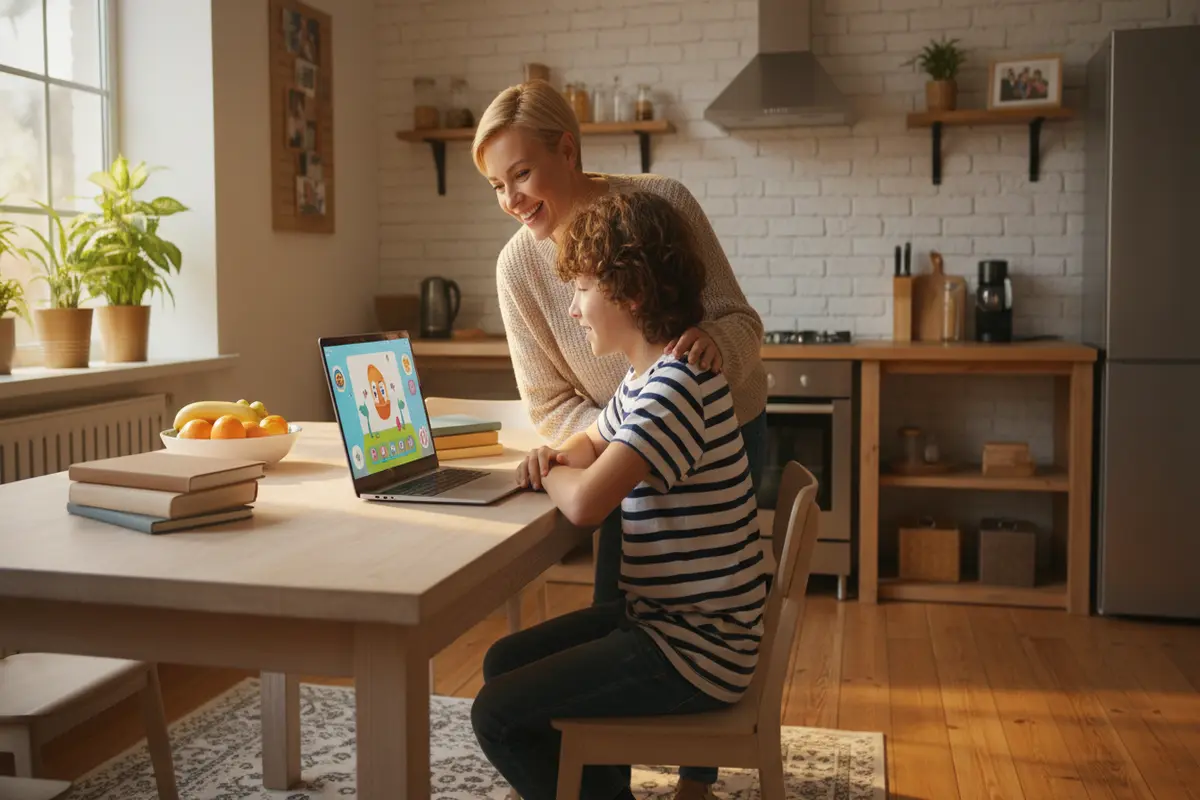
AI homework should be done in the living room or at the kitchen table. It should not be done alone in a bedroom behind a closed door. When it is out in the open, parents can peek at the screen to make sure the AI is teaching, not just giving answers.
Rule 2: The 15-Minute Rule.
Before using the AI, the child has to try to solve the homework on their own for 15 minutes. They must look at their textbook. They must try their best. Only after they have tried hard and are truly stuck can they ask the robot for a hint.
Rule 3: You must explain it to me.
If your child uses AI to solve a math problem, they have to turn around and teach you how they did it. If they can explain it clearly, it means they really learned it. If they just shrug and say, “The computer said it was 12,” then they have to do the problem again.
Rule 4: Never share secrets.
Teach your kids never to tell the AI their real name, what school they go to, or where they live. AI does not need to know personal secrets to help with spelling or science.
Following these rules ensures that technology remains a helpful friend, much like the amazing resources you can find over at The AI Homeschooler, which gives great tips on managing tech in education.
FAQ Section
Q1: Is using an AI homework helper considered cheating?
Answer: It depends on how you use it! If a student uses AI to write their paper or just copy the final math answers, yes, that is cheating. But if a student uses AI to ask for hints, practice spelling, or explain a confusing topic, it is just like having a helpful tutor.
Q2: At what age should kids be allowed to use AI for school?
Answer: Most experts say kids under 13 should only use AI with a parent sitting right next to them. Middle school and high school students can use it on their own, but only if they have been taught the rules of honesty and how to check facts.
Q3: Can teachers tell if my child used AI to do their homework?
Answer: Yes, often they can. Teachers know how their students normally write. If a 6th grader hands in an essay that uses college-level words like “furthermore” and “consequently,” the teacher will know a robot wrote it. There are also computer programs that teachers use to scan homework for AI.
Conclusion
Technology is moving so fast, and it can feel a little scary. But we do not have to be afraid of it. An AI homework helper for kids can be a wonderful, magical tool. It can end the late-night crying over math problems. It can give your child the extra support they need to feel smart and confident.
But you have to be the guide. Remember, the goal of school is not to just get the right answer on a piece of paper. The goal of school is to build a strong, smart brain. Teach your kids to use AI as a coach, not a cheat code.
Make learning fun and safe with technology. Tonight, discuss these rules with your child and try a smart prompt together. Want to boost their skills? Use our AI Reading Worksheet Generator to instantly create complete reading sets-stories, comprehension questions, answer keys, and printable worksheets on any topic.
Views: 0