
AI Tools for Special Needs Homeschooling (Complete Parent Guide)
Special needs homeschooling can be challenging for parents.
Every child has a unique learning style, and traditional teaching methods often don’t fit all learners.
This is where AI tools for special needs homeschooling make a real difference.
AI-powered tools help create personalized lessons, improve focus, and support children with learning differences such as autism, ADHD, and dyslexia – all in a flexible, stress-free way at home.
This complete guide to AI tools for special needs homeschooling explains how AI works, its benefits, real-life use cases, safety tips, and best practices for parents in 2026.
What Are AI Tools for Special Needs Homeschooling?
According to Understood.org, children with learning differences benefit most from individualized support. AI (Artificial Intelligence) tools use smart technology to understand how a child learns and then adapt lessons based on that data. Instead of fixed lessons, AI adjusts content to match a child’s pace, strengths, and challenges.
These tools can:
- Simplify difficult concepts
- Repeat lessons patiently
- Adjust difficulty automatically
- Use visuals, audio, and interactive activities
This makes learning more accessible and comfortable for children with special needs.
How AI Helps Special Needs Homeschooling (Step-by-Step)
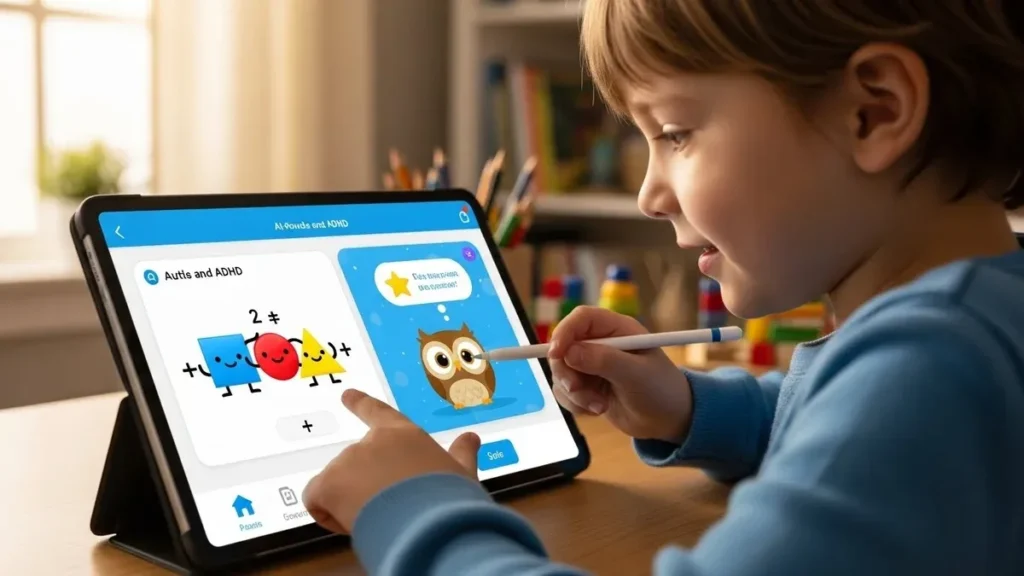
1. Personalized Learning Paths
AI analyzes progress and creates personalized learning paths tailored to the child. If a child struggles, the tool slows down and changes the teaching style.
2. Better Focus and Engagement
Interactive lessons, animations, and voice support help children stay engaged, especially those with attention challenges.
3. Self-Paced Learning
Children can repeat lessons as many times as needed without pressure. This builds confidence and reduces frustration.
4. Instant Feedback
AI provides immediate feedback, helping children understand mistakes in a positive and supportive way.
Benefits of AI for Special Needs Homeschooling
✔ Benefits for Children
- Builds confidence
- Reduces learning anxiety
- Improves understanding
- Encourages independent learning
✔ Benefits for Parents
- Saves lesson planning time
- Reduces teaching stress
- Tracks progress easily
- Supports multiple learning styles
AI supports parents but never replaces their role.
Best Use Cases of AI in Special Needs Homeschooling

🧩 Autism Spectrum
AI tools provide structured routines, visual schedules, and predictable lesson patterns, helping children feel safe and focused.
⚡ ADHD
Short lessons, interactive tasks, and gamified activities help maintain attention and interest.
📖 Dyslexia
Text-to-speech, speech-to-text, and reading support features make learning easier and less stressful.
🧠 Learning Delays
AI patiently repeats lessons and adjusts difficulty until the child understands the topic.
Real-Life Ways Parents Use AI at Home
- Creating daily lesson plans quickly
- Generating customized worksheets
- Practicing reading with voice-based tools
- Tracking learning progress automatically
Many parents combine AI tools with hands-on learning, like art, movement, and outdoor activities.
Common Mistakes to Avoid
- Relying only on AI without parent involvement
- Using too many tools at once
- Ignoring screen-time balance
- Not reviewing AI-generated content
AI works best with active parent guidance.
Safety & Best Practices
- Choose child-friendly AI tools
- Avoid sharing personal data
- Monitor screen time regularly
- Review lessons before use
- Balance digital learning with offline activities
Safety and supervision are always important.
Frequently Asked Questions (FAQs)
Is AI safe for special needs homeschooling?
Yes, when parents supervise and use trusted tools.
Can AI replace teachers or parents?
No. AI is a support tool, not a replacement for human guidance.
Is AI suitable for young children?
Yes, with age-appropriate tools and time limits.
Can AI help non-verbal children?
Some tools support visual communication and speech assistance.
How long should children use AI tools daily?
Short, focused sessions with breaks work best.
Final Thoughts
AI tools for special needs homeschooling help make learning more personalized, flexible, and supportive. When used correctly, AI can reduce stress for parents and help children grow at their own pace — academically and emotionally.
Start small, stay consistent, and focus on what works best for your child.
Top AI Tools for Special Needs Homeschooling in 2026
Choosing the right AI tools for special needs homeschooling can feel overwhelming. Here are some of the most trusted and parent-approved tools families are using successfully today:
- Khanmigo by Khan Academy – A safe, child-friendly AI tutor that helps with math, reading, and writing. Completely free and COPPA compliant. Great for ADHD and learning delays.
- Learning Ally – Audio textbooks and reading support specifically designed for children with dyslexia and other reading challenges.
- Snap&Read – A text-to-speech tool that reads any on-screen content aloud. Ideal for children with dyslexia or visual processing issues.
- ModMath – A digital graph paper app that helps children with dysgraphia and fine motor challenges write math problems neatly without frustration.
- Speechify – Converts text to natural-sounding audio. Excellent for older learners with dyslexia who struggle to read long passages.
How to Build a Daily Routine Using AI Tools for Special Needs Homeschooling
Children with special needs thrive on routine and predictability. A consistent daily structure using AI tools helps reduce anxiety, improve focus, and make learning feel manageable. Here is a sample daily routine many special needs homeschool families find effective:
- Morning warmup (15 minutes) – Use an AI reading or math tool to review yesterday’s lesson. This builds memory and confidence.
- Core subject one (20 to 30 minutes) – Work on the most challenging subject when the child is most alert. Use AI to explain concepts and check understanding.
- Movement break (10 minutes) – Physical movement is especially important for children with ADHD and autism. Walk, stretch, or play outside.
- Core subject two (20 to 30 minutes) – A second focused learning block. Let the child choose the subject to build motivation.
- Creative or hands-on activity (30 minutes) – Art, building, cooking, or gardening. Offline learning is just as important as screen-based AI tools.
Questions Parents Ask About AI Tools for Special Needs Homeschooling
What if my child has multiple learning differences?
Many children have overlapping needs, such as ADHD combined with dyslexia. Look for AI tools that support multiple learning styles at once. Khanmigo and reading-aloud tools work well across different needs.
How do I know if the AI tool is actually helping?
Watch for these signs: your child is less frustrated during lessons, they are completing more work independently, and they ask to use the tool on their own. Progress may be slow but should be steady over four to six weeks.
Should I tell my child they are using AI?
Yes. Being honest with your child about AI builds trust and digital literacy. Explain that the tool is there to help them learn, just like a calculator helps with math. Transparency at a young age sets healthy expectations for AI use throughout their life.
AI tools for special needs homeschooling are not a cure or a shortcut. They are patient, flexible learning partners that give your child one more way to succeed. Combined with your love, guidance, and involvement, they can make a real difference in your child’s confidence and academic growth.
The Best AI Tools for Special Needs Homeschooling in 2026
Special needs homeschooling requires tools that adapt genuinely — not tools that offer a simplified version of the same content everyone else gets. The best AI tools for special needs learners adjust pacing, presentation format, difficulty, and feedback style based on how the individual child actually responds. Here are the tools that do this most reliably in 2026.
For Learning Differences (Dyslexia, ADHD, Dyscalculia)
Dyslexic learners benefit most from tools that reduce the reading load without reducing the content. Speechify converts any text to audio, allowing a child to access grade-level science, history, or social studies content without the reading barrier. For math, StarSpark AI provides step-by-step explanations at a patient pace with no time pressure — which is critical for students who experience math anxiety or dyscalculia.
ADHD learners benefit from the shorter session format, immediate feedback, and progress rewards built into adaptive tools like Khan Academy and StarSpark. These tools naturally break learning into shorter chunks with clear completion signals, which is more manageable than a 45-minute textbook chapter.
Try StarSpark AI — Patient Math Practice for Every Type of Learner
For Autism Spectrum (ASD)
Many students on the autism spectrum respond well to AI tutoring specifically because of its consistency. AI tools give the same explanation the same way every time, with predictable response patterns and no social unpredictability. Khanmigo’s structured Socratic questioning works particularly well for ASD learners who are academically capable but struggle with the social dynamics of traditional classroom interaction. The tool is patient, consistent, and never frustrated.
For Gifted Learners
Gifted homeschool students often struggle with pacing — they master content faster than any fixed curriculum can deliver it. Math Academy addresses this directly with a system that compresses 180 classroom hours of math into 20 to 40 focused hours. For gifted learners who are significantly ahead in math, Math Academy provides appropriately challenging content without requiring the parent to source advanced curriculum independently.
How to Structure a Special Needs Homeschool Day With AI
The key principle for special needs homeschooling is to match the format of delivery to the child’s specific profile, not to a standard school schedule. AI tools make this significantly more practical. Here is a flexible structure that works across a range of special needs profiles:
- Short focused sessions (15-20 min): Most special needs learners perform better in multiple short sessions than in one long block. AI tools naturally support this with session-based structure.
- Immediate feedback: Do not delay feedback. AI tools provide it instantly, which is especially important for ADHD and ASD learners who benefit from knowing immediately whether their answer was correct.
- Multimodal delivery: Use audio (Speechify), visual (Curipod), and interactive (StarSpark, Khanmigo) tools in rotation. Changing the delivery format maintains engagement and accommodates different processing styles.
- Parent review daily: Check session dashboards every day. Special needs learners can appear to be making progress while actually developing workarounds. Daily review catches this early.
Frequently Asked Questions
Do I need a diagnosis before using special needs AI tools?
No. The tools listed here are appropriate for any child who benefits from adaptive pacing, alternative delivery formats, or patient one-on-one practice — regardless of whether a formal diagnosis exists. If your child is struggling in ways that standard curriculum does not address, trying adaptive AI tools is a reasonable first step that does not require waiting for an evaluation.
How much do these tools cost?
Khan Academy and Khanmigo are free. Speechify has a free tier. StarSpark offers a free trial. Grammarly has a strong free version. Co:Writer and Math Academy are paid. Most special needs homeschool families find they need one or two paid tools alongside free options, typically spending between $10 and $30 per month total.
Related: Best AI tools for homeschool parents and free AI lesson planners guide.
Views: 0