
Top AI Math Tutor Middle School Tools for Better Grades

Middle School Math (Algebra, Geometry) is where students often struggle and lose confidence. This shift may indicate curriculum issues, and AI can help. Teachers in classrooms can’t address every student’s individual difficulties.
Traditional private tutoring is a wonderful luxury, but at $50 to $100 per hour, it is out of reach for many families. Furthermore, a human tutor isn’t there at 8:30 PM when a student is stuck on their third geometry proof. This is where an AI math tutor for middle school becomes a game-changer for your child’s education.
An AI math tutor is a digital platform that uses machine learning and Natural Language Processing to act as a personalized coach. Unlike a simple calculator, these tools “see” the problem through a camera or text input and guide the student through the logic of the solution.
The primary value of these tools lies in reducing math anxiety. When a student has a judgment-free, 24/7 resource to explain a concept, they move from frustration to mastery much faster. We have found that consistent use of AI tutors can bridge the learning gap by up to two grade levels in a single school year.
Affiliate Disclaimer: This post may contain affiliate links, meaning we receive a commission if you decide to make a purchase through our links, at no cost to you. We only recommend tools we have personally vetted for educational quality.
Key Takeaways
- Step-by-step guidance turns “cheating” into “learning” by explaining the “why” behind every operation.
- 24/7 availability ensures students never hit a “dead end” during late-night homework sessions.
- Personalized pacing allows middle schoolers to revisit foundational concepts they might have missed in earlier grades.
- Top recommended tools for 2026 include Khanmigo, Photomath, and Microsoft Math Solver.
What is an AI Math Tutor for Middle School?
An AI math tutor for middle school is an intelligent software tool designed to provide personalized, step-by-step instruction for students aged 11-14. These tools use artificial intelligence to analyze mathematical problems, offer conversational hints, and adapt to a student’s specific learning pace to improve grades and confidence.
- Key Takeaways
- Bridging the Gap Between Concrete and Abstract Math
- Developing Independent Study Habits
- Reducing Math Trauma Through Private, Judgment-Free Practice
- Photomath – The Leader in Instant Problem Solving
- Khan Academy (Khanmigo) – The Gold Standard for Guided Learning
- Microsoft Math Solver – Best for Multi-Format Input
- Mathway – The Comprehensive Tool for Complex Equations
- Brainly – Combining AI with Peer-to-Peer Support
- Handwriting Recognition and Camera Input
- Step-by-Step Explanations (The Why Behind the How)
- Progress Tracking for Parents and Teacher
- Gamification and Engagement Elements
- Reinforcing Concepts Taught in School
- Preparing for High-Stakes Standardized Testing
- Providing Support for Students with Learning Differences (Dyscalculia)
- Data Privacy for Minor Students (COPPA Compliance)
- Vetted Content vs. Generative AI Hallucinations
Why Middle School is the Critical Phase for AI Math Support
Bridging the Gap Between Concrete and Abstract Math
Middle school is the period where math shifts from concrete numbers to abstract variables.
I have observed that many students struggle because they cannot visualize what “X” represents. AI tools use interactive graphs and visual aids to make these abstract concepts tangible.
Developing Independent Study Habits
At this age, students are expected to take more ownership of their work. An AI tutor acts as a scaffold.
It provides enough help to keep the student moving forward without doing the work for them, which is essential for building long-term academic independence.
Reducing Math Trauma Through Private, Judgment-Free Practice
Many students are afraid to raise their hands in class for fear of looking “slow.” AI provides a safe space.
A student can ask the same question ten times, and the AI will answer patiently ten times, preventing the “math trauma” that often starts in the 6th or 7th grade.
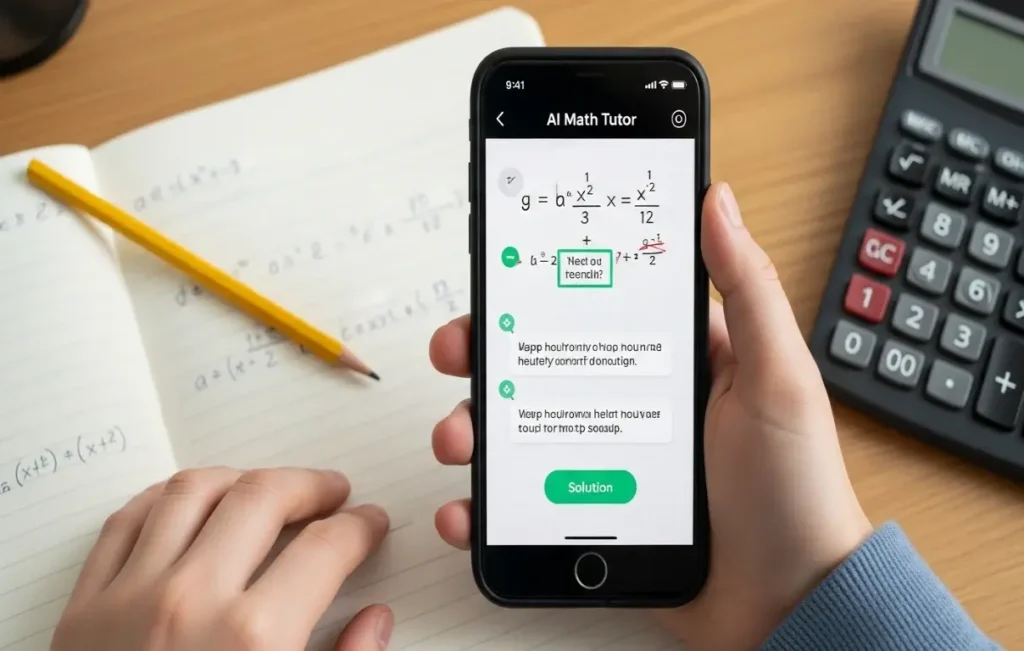
The Best AI Math Tutor Middle School Tools for 2026.
Photomath – The Leader in Instant Problem Solving
Photomath is the most popular tool for a reason.
By simply scanning a handwritten problem with a smartphone camera, students get an instant breakdown.
I recommend it specifically for students who struggle with the mechanics of multi-step equations.
Khan Academy (Khanmigo) – The Gold Standard for Guided Learning
Khanmigo is perhaps the most “tutor-like” AI available. Instead of giving the answer, it uses a Socratic method.
It asks the student, What do you think the first step should be?
This makes it my top choice for deep conceptual understanding. For a detailed look at how these platforms compare to specialized tools,
you can read our StarSpark AI Math Tutor review to see how different AI engines handle student logic.
Microsoft Math Solver – Best for Multi-Format Input
Microsoft’s tool is excellent because it allows students to type, draw, or scan problems.
It also links directly to related video tutorials, which is helpful for students who are visual learners and need to see a teacher solve similar problems on a whiteboard.
Mathway – The Comprehensive Tool for Complex Equations
Mathway covers everything from basic fractions to pre-algebra and beyond.
While the interface is more clinical, its database of solutions is massive.
It is a reliable “safety net” for more advanced middle school students taking high-school-level courses.
Brainly – Combining AI with Peer-to-Peer Support
Brainly uses AI to scan its massive database of student-submitted questions.
Its AI “Ginny” helps refine answers and ensures that the step-by-step explanations meet educational standards.
It adds a social layer to the learning process.
Expert Pro-Tip #1: Use AI to Learn, Not Just to Solve
To get the most out of an AI math tutor, students should use the “Explain it to me like I am five” technique. When the AI provides a solution, have the student ask the AI to explain a specific step in simpler terms. This forces the AI to move away from formulas and into conceptual language.
I also encourage parents to have their children “teach” the AI’s explanation back to them. If a student can explain the AI’s logic to a parent, they have truly mastered the material.
Data Comparison Table: Top AI Math Tutors at a Glance
| Tool Name | Primary Strength | Best For | Pricing Model | Unique AI Feature |
|---|---|---|---|---|
| Photomath | Speed/Camera Accuracy | Quick Homework Checks | Free/Paid Plus | Animated Tutorials |
| Khanmigo | Socratic Coaching | Deep Conceptual Learning | Monthly Subscription | Won’t give direct answers |
| MS Math Solver | Versatility | Visual Learners | Free | Direct link to Video Lessons |
| Mathway | Equation Coverage | Advanced Students | Free/Paid | Massive Topic Database |
| Brainly | Community Context | Word Problems | Free/Paid | AI-Verified Peer Answers |
Key Features to Look for in an AI Math Tutor
Handwriting Recognition and Camera Input
Middle schoolers rarely type their math. A tool must be able to read messy 7th-grade handwriting accurately.
Photomath and Microsoft lead the pack here, saving students the frustration of manual data entry.
Step-by-Step Explanations (The Why Behind the How)
If an app only gives the final answer, it is a calculator, not a tutor.
The best AI tools highlight each individual transformation in an equation, explaining the mathematical property used (e.g., the Distributive Property).
Progress Tracking for Parents and Teacher
Look for tools that provide a weekly summary.
I find that parents feel much more “in the loop”
when they can see which topics (like ratios or decimals) their child struggled with most during the week.
Gamification and Engagement Elements
Middle schoolers respond well to rewards. Apps that use “streaks,” badges, or points can turn a boring homework session into a game, which is vital for maintaining long-term engagement.
How AI Tutoring Complements Classroom Instruction
Reinforcing Concepts Taught in School
AI is not a replacement for a teacher; it is a reinforcement. If a teacher introduces the Pythagorean theorem on Tuesday, the student can use the AI on Tuesday night to practice twenty variations of that specific concept. This extra practice is vital for success in core subjects, as noted in our Time4Learning 8th grade curriculum review.
Preparing for High-Stakes Standardized Testing
In many states, middle school determines high school placement.
AI tutors can simulate test environments and provide timed practice,
helping students manage the “clock anxiety” that often lowers their scores.
Providing Support for Students with Learning Differences (Dyscalculia)
For students who struggle with number sense or Dyscalculia,
AI tools can read problems aloud or use color-coded steps to make the logic easier to follow.
This level of accessibility is rarely available in standard textbooks.
Expert Pro-Tip #2: Setting Digital Boundaries for Math Success
PRO-TIP: Implement a “Verify First” rule. I suggest that students attempt to solve at least 50% of the problem on paper before opening the AI app. Use the AI to check the work or get “unstuck” at a specific step. This ensures the brain is doing the heavy lifting, while the AI provides the safety net.
Safety and Privacy: Choosing the Right Tools
Data Privacy for Minor Students (COPPA Compliance)
When choosing an AI math tutor for middle school, check if they are Children’s Online Privacy Protection Rule (COPPA) compliant.
Tools like Khan Academy are built with student privacy as a foundational requirement.
Vetted Content vs. Generative AI Hallucinations
Be cautious with general AI like ChatGPT for math.
While it is improving, it can occasionally “hallucinate” or provide incorrect calculations.
Specialized math AI tools are much more reliable because they use symbolic math engines rather than just predicting the next word.
For parents looking for the most secure and effective platforms, we have compiled a list of the best AI tutors for homeschooling parents that prioritize safety and educational accuracy.
Step-by-Step Implementation Guide for Parents
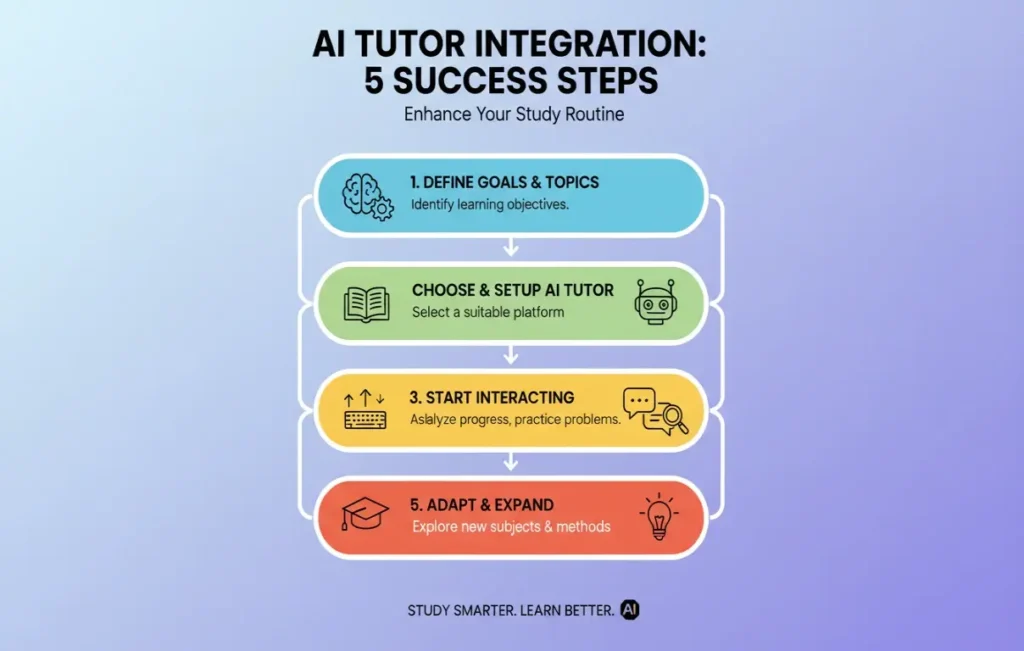
- Download two different apps (e.g., Photomath for quick checks and Khanmigo for deep learning).
- Sit with your child for the first 15 minutes of use to ensure they are reading the steps, not just copying the answer.
- Set a specific “AI Math Time” during homework to prevent the app from being a constant distraction.
- Review the “History” or “Progress” tab at the end of every week to identify recurring struggle points.
- Encourage your child to use the “Ask a Follow-up” feature to dive deeper into confusing steps.
Frequently Asked Questions (FAQ)
Is an AI math tutor better than a human tutor?
AI is better for immediate, 24/7 support and cost-effectiveness. However, a human tutor is still superior for emotional encouragement and identifying complex behavioral learning blocks. Most students benefit from a hybrid approach.
Are these AI math tools free?
Many tools like Photomath and Microsoft Math Solver offer robust free versions. Advanced features, such as deep-dive video explanations or 1-on-1 AI chat, often require a monthly subscription.
Can middle schoolers use ChatGPT for math homework?
I recommend against using standard ChatGPT for math. Instead, use “GPTs” specifically designed for math or specialized tools like Khanmigo, as they are less likely to make calculation errors.
Do these apps work for word problems?
Yes, tools like Khanmigo and Brainly are excellent at parsing the text of word problems to identify the underlying mathematical equation.
How can I track my child’s progress with an AI tutor?
Most premium AI tutoring apps offer a parent dashboard or weekly email reports that show time spent, topics mastered, and areas where the student is still struggling.
Conclusion
The transition to middle school math doesn’t have to be a source of family stress. By leveraging an AI math tutor for middle school, you are giving your child a private coach that never gets tired and never loses patience.
These tools bridge the gap between classroom instruction and independent mastery, ensuring that students stay on track for high school success. I recommend starting with Photomath for immediate help and Khanmigo for building long-term skills.
Download one of these tools today and watch your child’s math anxiety transform into academic confidence.
Views: 0