
How Parents Track Homeschool Progress Without Stress (A Clear, Step-by-Step AI System)
“My child studies every day… but how do I know it’s actually working?”
If you are a homeschooling parent, this thought has probably crossed your mind—maybe late at night, maybe while planning the next week, or maybe after talking to another parent.
Your child is:
- Completing lessons
- Watching videos
- Doing worksheets
Yet a quiet doubt remains:
“Is my child really improving, or are we just staying busy?”
This confusion is one of the most common and emotionally draining problems homeschooling parents face.
And here’s the truth you rarely hear:
👉 The problem is not you.
👉 The problem is not your child.
👉 The problem is the lack of a clear progress-tracking system.
In this guide, you’ll learn exactly how parents can track homeschool progress using a simple, AI-assisted system—step by step, without confusion, pressure, or overwhelm.
Why Tracking Homeschool Progress Feels So Hard for Parents
Traditional schools rely on:
- Grades
- Standardized tests
- Report cards
Homeschooling doesn’t always have those built in.
Most parents end up tracking progress by:
- Gut feeling
- Comparing siblings
- Comparing with other kids
- Random quizzes
That leads to:
- Stress
- Self-doubt
- Over-teaching or under-teaching
Many parents quietly wonder:
“Am I doing enough… or am I failing my child?”
If that sounds familiar, take a deep breath. You’re not alone.
The Big Shift Parents Need to Make (This Changes Everything)
Before tools, schedules, or apps, there’s one mindset shift:
❌ Feelings are not progress
✅ Data + consistency is progress
You don’t need:
- Daily long tests
- Complex reports
- School-style pressure
You need a simple, repeatable system.
This is where AI tools for homeschooling parents become powerful—not to replace you, but to support you.
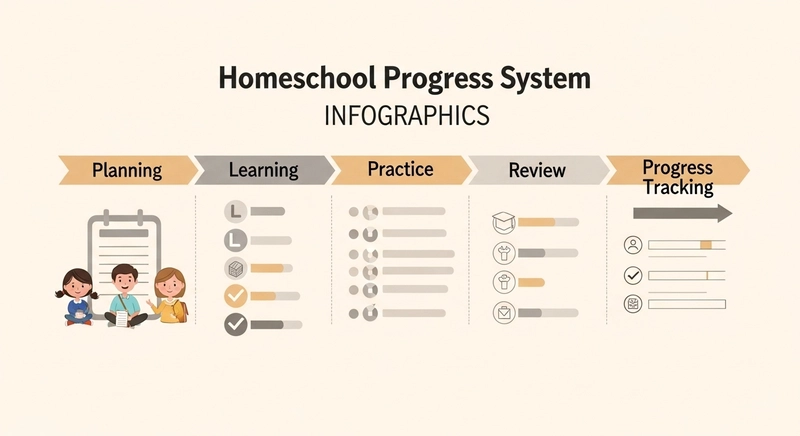
The Parent-Friendly AI System to Track Homeschool Progress
(No confusion, no tech overwhelm)
Let’s break it down into clear, practical steps.
Step 1: Define Clear, Short Learning Goals (Not Vague Ones)
Most parents say:
- “I want my child to be better at math.”
- “I want to read to improve.”
These goals are too broad.
Instead, define short, measurable goals.
Examples:
- Math: “Understand fractions up to ½ and ¼ in 2 weeks.”
- Reading: “Read 10 minutes daily with fewer pauses.”
- Writing: “Write one clear paragraph with correct punctuation.”
💡 Personal insight:
When I started homeschooling, I thought flexibility meant “no structure.”
In reality, clarity creates freedom, not restriction.
Step 2: Take a Baseline Snapshot (This Is Critical)
You can’t track improvement if you don’t know the starting point.
Do this once:
- Create a short quiz (10–15 questions)
- Keep it relaxed
- No pressure, no time limit
AI can easily generate these baseline questions based on your child’s level.
👉 This baseline is not a judgment.
👉 It’s just a snapshot.
Save this result. You’ll come back to it later.
Step 3: Break Learning Into Daily Micro-Tasks
Big lessons create overwhelm—for both parent and child.
Instead:
- 20–30 minutes per session
- One concept at a time
- Stop before frustration starts
Example (Math):
- Day 1: What is a fraction?
- Day 2: Fractions using food or objects
- Day 3: Simple fraction comparison
This method is especially effective for homeschool progress tracking for kids because improvement becomes visible faster.
Step 4: Use AI as an “Assistant Teacher,” Not a Replacement
This is where many parents misunderstand AI.
AI is not there to:
- Replace your role
- Take control
AI is there to:
- Explain concepts in different ways
- Answer “why” questions patiently
- Provide extra practice
When your child asks:
“I don’t get this…”
You don’t have to panic or feel inadequate.
AI can:
- Re-explain with stories
- Use examples your child relates to
- Adjust difficulty instantly
This reduces parent stress dramatically.
Step 5: Daily Practice + Instant Feedback
Progress doesn’t come from lessons alone—it comes from feedback.
After each session:
- 5–7 short practice questions
- Review immediately
- Correct mistakes gently
AI helps by:
- Checking answers
- Explaining mistakes clearly
- Suggesting what to practice next
This prevents the “we learned it once but forgot everything” problem.
Step 6: Weekly Mini-Check (Not a Scary Test)
Once a week:
- 10–15 minute quiz
- Same topics you practiced
- Calm environment
Compare:
- This week’s result
- Last week’s result
Not to judge—but to observe trends.
This is a core part of how parents track homeschool progress without stress.

Step 7: Weekly Homeschool Planning With AI (The Game-Changer)
Here’s where things truly click.
Every weekend, ask AI to:
- Summarize the week
- Identify strong areas
- List weak topics
- Suggest next week’s focus
This creates a weekly homeschool planning with an AI system that feels calm and intentional.
Instead of asking:
“What should we do next?”
You’ll know exactly what to do.
Step 8: Keep a Simple “Weak Topics” List
Use a notebook or digital doc.
List:
- Topics that caused confusion
- Concepts needing revision
Review this list weekly.
This stops random revision and saves time.
Step 9: Monthly Comparison (This Builds Confidence)
At the end of each month:
- Compare current performance with baseline
- Look at speed, accuracy, and confidence
Most parents are shocked here—in a good way.
You’ll often realize:
“Wow… my child has actually come a long way.”
This moment alone removes so much doubt.
Step 10: Adjust the System, Not the Child
If progress slows:
- Change the method
- Change the explanation
- Change the schedule
Do not label your child as:
- Lazy
- Slow
- Not trying
Homeschooling success comes from flexibility, not pressure.
Why This System Works So Well for Parents
✔ Clear goals
✔ Visible improvement
✔ Less emotional guessing
✔ Less burnout
AI becomes your:
- Planner
- Tutor
- Progress tracker
And you remain what matters most:
👉 The parent who understands their child best
Common Mistakes Parents Should Avoid
- Using too many tools at once
- Over-testing
- Comparing with other children
- Expecting school-style results
Homeschooling is not school at home.
It’s learning designed around your child.
Helpful External Resources (Trusted)
For additional guidance and research-based insights:
- Homeschool Legal Defense Association (HSLDA) –
- Edutopia’s learning assessment resources –
These reinforce that assessment doesn’t have to be stressful to be effective.
Internal Resources on This Blog (Recommended)
To go deeper, you can explore:
- AI Homeschool Weekly Workflow for Parents
- Best AI Tools for Homeschooling Parents
- How AI Reduces Homeschool Parent Burnout
These resources complement the system explained above and improve long-term results.
Final Thoughts: You’re Not Behind—You Just Needed a System
If you’ve ever felt:
- Confused
- Anxious
- Unsure
Please remember:
Homeschooling success is not about doing more.
It’s about seeing clearly.
Once you know how parents track homeschool progress with a simple, AI-supported system, everything feels lighter:
- Planning becomes easier
- Teaching feels calmer
- Confidence grows
And your child benefits from a parent who is no longer second-guessing every step.
The Best AI Tools for Tracking Homeschool Progress
Manual progress tracking — notebooks, spreadsheets, printed portfolios — takes significant time and often creates a false sense of thoroughness. A thick binder does not tell you whether your child actually understood what they studied. AI-powered tracking tools give you real data on actual mastery, not just completion. Here are the tools that do this best.
Khan Academy Parent Dashboard
Khan Academy’s parent dashboard is one of the most useful free tracking tools available. It shows which skills your child has practiced, which are mastered, and which need more work — updated in real time after every session. You can see how many minutes were spent, which exercises were attempted, and the accuracy rate on each concept. For math and science tracking, this dashboard alone can replace a significant amount of manual record keeping.
StarSpark AI Progress Tracking
StarSpark AI’s parent dashboard goes further than a simple completion log. It shows which math concepts are genuinely mastered versus recently practiced, identifies the specific areas where your child is struggling, and gives you week-over-week progress data. For homeschool parents who need to document math progress for state requirements or portfolio reviews, StarSpark’s reports are clear and professionally formatted.
Try StarSpark AI — Clear Math Progress Tracking for Homeschool Families
ChatGPT for Portfolio Documentation
For homeschool families in states that require portfolio documentation, ChatGPT can significantly reduce the time spent writing progress narratives. Keep a simple weekly log of what subjects were covered and what your child produced. Then prompt ChatGPT: “Based on these notes from our homeschool week, write a one-paragraph progress narrative for a 4th grade portfolio. Focus on growth and mastery rather than just completion.” Review, adjust if needed, and add to your portfolio. What used to take an hour takes five minutes.
A Simple Weekly Tracking System Using AI
- Daily (2 minutes): Check the Khan Academy and StarSpark dashboards. Note anything that needs attention tomorrow.
- Weekly (10 minutes): Review the week’s session data across all AI tools. Note which concepts were mastered and which are still in progress.
- Monthly (20 minutes): Use ChatGPT to generate monthly progress summaries from your weekly notes. These summaries form the basis of any portfolio or state documentation required.
- Quarterly (30 minutes): Generate a full quarter report. Compare to where your child started. This comparison data is the most compelling evidence of educational progress for any external review.
Frequently Asked Questions
What records do I need to keep for homeschooling?
Requirements vary significantly by US state. Most states require some form of attendance documentation, a list of subjects covered, and evidence of educational progress. A small number of states require annual assessments or portfolio reviews. Check your state’s specific requirements before deciding what to track. AI dashboard reports from tools like Khan Academy and StarSpark provide ready-made documentation that satisfies most state requirements.
How do I track progress in subjects without AI tools?
For subjects not covered by AI tools — art, physical education, music, foreign language — keep a simple dated log of activities completed and a brief note on what was produced or demonstrated. Photographs of artwork, recordings of music practice, and descriptions of physical activities are all valid portfolio evidence. ChatGPT can help you write these entries quickly from rough notes.
Related: Best AI tools for homeschool parents and free AI lesson planners guide.
Views: 1