
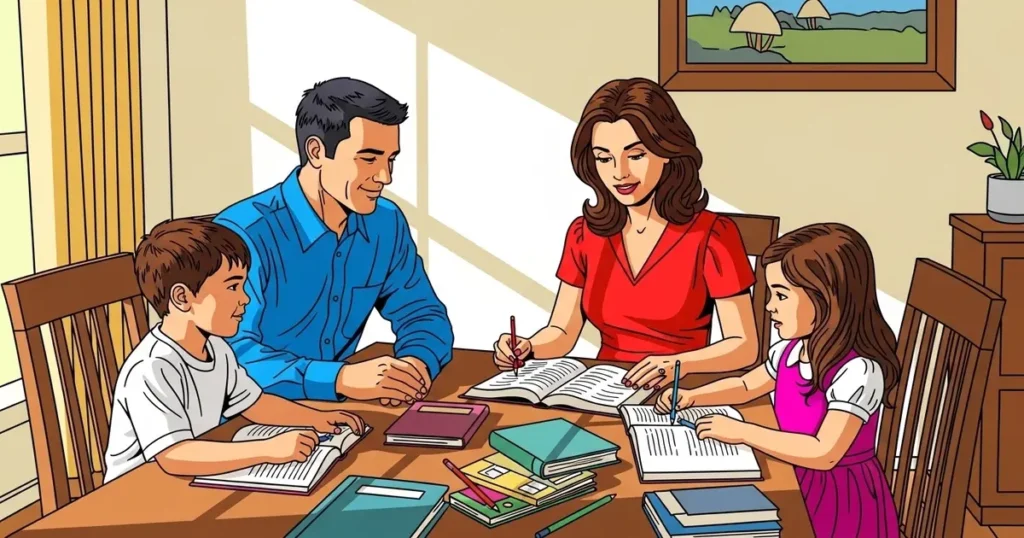
Honestly? When I first started looking for a christian homeschool curriculum, I felt like I was drowning in a sea of workbooks and felt-board stories.
I remember sitting at my kitchen table at 11:00 PM, wondering if I was failing my kids before we even started. Talk about overwhelming!
It’s that “overwhelmed-mom-paralysis” where every program looks amazing, but you’re terrified of picking the “wrong” one.
The best christian homeschool curriculum aligns with your family’s values, fits your child’s unique learning style, and—most importantly—is actually sustainable for you to teach.
Look for programs like Abeka, BJU Press, or Gather ‘Round that blend academic rigor with a biblical worldview. Seriously, don’t pick something that’ll make you want to pull your hair out.
Grab a second cup of coffee. Or maybe wine? No judgment here! We’re going to walk through this together, exploring options for your Christian homeschooling journey.
Ready? Let’s dive in. This isn’t rocket science, just a whole lot of choices.
Choosing Your Ideal Christian Homeschool Curriculum: Top Options & Reviews
When you start asking around, a few names always pop up. These are the heavy hitters, often recommended for their comprehensive approach to Christian education.
I mean, everyone’s heard of them, right?
Abeka: Structured Learning and Traditional Christian Homeschool Curriculum
Abeka is basically the “OG” of Christian education. It’s very structured, very academic, and very traditional.
Like, picture a really neat classroom with everyone in their desks. That’s Abeka. If you love a clear plan and want your kids to have a super solid foundation in the basics, Abeka’s structured christian homeschool curriculum is a win.
My personal take? It gives you a roadmap. Just a heads up: it can involve a lot of “seat work.” And sometimes, kids just wanna run around!
BJU Press: Deep Biblical Integration Across Christian Homeschool Subjects
BJU Press is another massive name in Christian education. I’ve seen them integrate the Bible into every single subject, from science to history.
It’s truly impressive. They offer amazing video lessons too, which can be a lifesaver for busy parents teaching subjects like high school chemistry.
Who even remembers organic chemistry from high school? This christian homeschool curriculum often provides a robust Christian worldview, and that’s super important to many of us.
Accelerated Christian Education (ACE): Self-Paced Christian Learning Programs
ACE uses little workbooks called “PACEs.” If you have a child who loves to “check the box” and work independently, this is a great option for Christian students.
My nephew absolutely thrived on these; he loved seeing his progress! It’s excellent for building confidence as students see their daily accomplishments.
Plus, it’s very affordable compared to some big box sets for spiritual and academic growth. Budget-friendly and effective? Yes, please!
To help you decide, here’s a quick comparison of some popular Christian curriculum providers:
Curriculum | Teaching Style | Best For… |
|---|---|---|
Abeka | Traditional/Spiral | Strong Phonics & Math Foundations |
BJU Press | Teacher-Led/Video | Deep Biblical Integration |
ACE (PACEs) | Independent | Self-Paced Learners |
Gather ‘Round | Unit Study | Families learning together |
Aligning Your Homeschool Vibe with Christian Curriculum Options
Before investing in any christian homeschool curriculum, consider your family’s “vibe,” or educational philosophy.
This reflects how you and your children naturally learn and thrive. For instance, if you spend weekends hiking, a rigid, desk-bound christian homeschool curriculum might not suit your family’s style.
It just wouldn’t fit, you know?
The Charlotte Mason Approach: Nurturing a Love for Christian Learning Resources
Think “living books,” nature walks, and handicrafts. It’s all about beauty and atmosphere in a Christian context.
Programs like Simply Charlotte Mason or The Good & the Beautiful fall into this category. It’s a gentle, lovely method that feels less like “school” and more like enriched “life.”
This approach often integrates faith organically. And I mean, who doesn’t want their kids to love learning from a solid christian homeschool curriculum?
Unit Studies: Engaging Families with Christian Themes in Homeschooling
This approach focuses on one topic, like “The Life of Jesus” or “Ancient Egypt,” and teaches every subject through that lens.
Gather ‘Round Homeschool is super popular for this, offering a cohesive Christian homeschool curriculum. My friend Jessica swears by it, says it transformed their homeschool days!
You can teach all your children, from kindergartner to 8th grader, at the same time using the same core lesson. This is a game-changer for maintaining sanity and fostering a shared learning experience.
Imagine—no scrambling for different lessons for each kid! If you’re curious about how technology can help manage all these different styles, you should check out our guide on homeschool AI tools.
They can significantly aid in planning your Christian learning journey. Seriously, these tools are game-changers for busy parents.
Real Talk: Managing the Costs of Christian Homeschooling
Homeschooling involves more than just curriculum costs. Oh, Lord, yes. Consider printer ink, craft supplies, field trips, and even coffee runs for mom!
Don’t forget that coffee! When choosing a christian homeschool curriculum, analyze what’s included.
Do you need expensive lab kits or comprehensive teacher’s manuals? Sometimes a cheaper christian homeschool curriculum might require more expensive supplements. It’s a tricky balance, right?

High-Quality Free & Low-Cost Christian Curriculum Options
Easy Peasy All-in-One Homeschool: This is a 100% free, online-based christian homeschool curriculum, a labor of love for thousands of families. Free! Can you believe it?
Ambleside Online: A free Charlotte Mason curriculum where you mainly need to find or buy the recommended “living books.” So many great reads in there.
The Peaceful Press: Offers beautiful, literature-based Christian units that are very affordable. My neighbor used one of their units on “The North American Indians” and just raved about it.
Education shouldn’t put you in debt. The National Center for Education Statistics shows a surge in homeschooling, with families finding creative ways to save on costs while maintaining high standards, especially within Christian education.
Good for them!
Integrating Faith Organically into Your Christian Homeschool Curriculum
A primary goal of choosing a christian homeschool curriculum is to nurture our children’s faith. However, sometimes biblical integration can feel forced.
Like, really forced, you know? True biblical integration teaches children to think through a biblical worldview, exploring how God’s order is evident in science or His hand in historical events.
It just makes sense when it’s natural, right?
Leveraging Scripture in Your Homeschool Day with Christian Materials
Most curricula include a Bible subject, but don’t feel constrained by it. Some of our best “school” moments involve reading a chapter of Proverbs and discussing it at breakfast.
Simple. Effective. The christian homeschool curriculum is a tool, not your master. Feel free to adapt it to your family’s unique spiritual rhythm.
If you’re feeling robotic, explore personalized homeschool scheduling to find time for genuine discipleship. Because it’s about discipleship, not just checking boxes.
What About Socialization? Dispelling Christian Homeschooling Myths
The “socialization” question is common, but homeschooled children are often well-socialized. So much for that myth!
Studies, like those from HSLDA, suggest homeschooled kids interact across age groups effectively. Imagine that!
Many Christian curriculum providers offer “Co-op” versions to facilitate group learning and social interaction. Joining local groups using curricula like Classical Conversations can be invaluable for social development.
Plus, co-ops are fun!
Common Struggles and Solutions in Christian Homeschooling
Homeschooling can be challenging. So very challenging. It’s okay if your chosen christian homeschool curriculum isn’t perfect, or if a child has an off-day.
We all have ’em.
My “Pantry Moment” and Christian Homeschool Curriculum Flexibility
Last year, an intense, expensive classical curriculum proved overwhelming. My kids struggled, and I felt like a failure.
Total pantry moment, complete with tears. But I realized I could change the rules! We switched to a more relaxed, literature-based approach.
If a christian homeschool curriculum creates more tension than learning, it’s absolutely acceptable to pivot. You have permission to find a better fit for your family and your Christian values. Seriously, give yourself grace!
Frequently Asked Questions About Christian Homeschool Curriculum
Is Christian homeschool curriculum accredited?
Curriculum itself isn’t accredited; schools are. However, many providers (e.g., Abeka Academy, BJU Press Homeschool) offer “Academy” versions that manage records for accreditation, which benefits college transcripts.
Good for college-bound kiddos!
Can I mix and match different Christian curriculum programs?
Absolutely! This is called “Eclectic Homeschooling.” You can use Abeka for Math, BJU for Science, and library resources for History.
It’s like a buffet—choose what works best for your family’s Christian education. Why not?
How long does a typical homeschool day take with a Christian curriculum?
For elementary kids, usually 2-3 hours. Middle and high school might take 4-5 hours. It’s faster than traditional school due to no “wait time” or classroom management issues, allowing more focused Christian learning.
No bus schedules! What a perk!
What if my kid is behind in a certain subject?
That’s the beauty of homeschooling! You can use a 2nd-grade math book for a 4th grader—no shame. Focus on bringing them up to speed at their own pace.
Learn more about adapting curriculum for different levels on our blog. Every child is different, right?
Do I need a degree to teach my kids with a Christian homeschool curriculum?
In most states, no. A high school diploma or GED is usually sufficient. Check the Homeschooling in the United States Wikipedia page for overall laws, but always verify with your specific state’s department of education website.
Don’t just take my word for it, double-check!
Is it expensive to homeschool using a Christian curriculum?
It can range from free to over $1,000 per child. Most families spend around $300-$600 per child annually on a quality christian homeschool curriculum and supplies, making it a flexible option.
There truly is something for every budget.
Final Encouragement for Your Christian Homeschooling Journey
You’re doing a great job. No, really. Whether you choose an “all-in-the-box” christian homeschool curriculum or create your own, God has called you to this journey, and He will provide the grace.
He always does. Don’t compare your “Day 1” to someone else’s “Year 10.” Your homeschool doesn’t need to be Pinterest-perfect; it just needs to fit your family.
If you’re feeling stuck on planning, see how AI can handle the busy work, allowing you to focus on the heart of Christian education. Because that’s what truly matters.
I’m curious—what concerns you most about starting your Christian homeschool journey this year? Drop a comment! Let’s chat about it.