
Best Second Grade Curriculum Homeschool Guide (2026)
Are you struggling to choose the right second grade curriculum homeschool plan for your child?
You’re not alone. Many parents feel overwhelmed by curriculum options, teaching styles, and state requirements.
The good news? With the right structure and a clear plan, second grade can become one of the most confident and joyful homeschool years for your family.
Affiliate Disclosure: This article contains affiliate links. If you purchase through these links, we may earn a small commission at no extra cost to you. We only recommend resources that genuinely support homeschool families.
Why a Structured Second Grade Curriculum Homeschool Plan Matters
Second grade is when children:
- Build strong reading fluency
- Master addition and subtraction
- Develop independent thinking
- Ask deeper questions about the world
A clear second grade curriculum homeschool structure helps you guide that growth confidently and without stress.
Before beginning, check your state homeschool laws through:
Core Subjects in a Second Grade Homeschool Curriculum
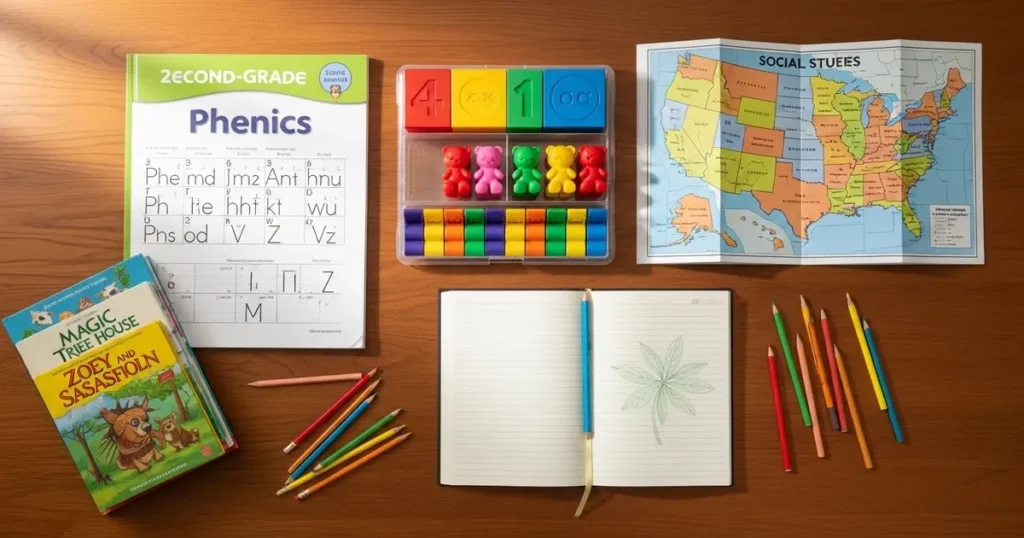
Reading & Phonics
Second grade moves from “learning to read” to “reading to learn.”
Focus on:
- Phonics mastery
- Sight words
- Reading comprehension
- Vocabulary development
If structured writing and reading support is needed, you can explore helpful AI-assisted tools here:
Writing & Grammar
Work on:
- Sentence structure
- Paragraph writing
- Capitalization
- Punctuation
- Journaling
Math Foundations
Second grade math includes:
- Addition & subtraction fluency
- Place value to 1,000
- Telling time
- Counting money
- Basic fractions
If math feels frustrating, see:
Science
Keep science hands-on:
- Plants & animals
- Weather
- Human body
- Simple experiments
Social Studies
Cover:
- Community
- Maps & geography
- Early U.S. history
- Citizenship
Step-by-Step: Planning Your Second Grade Homeschool Year
- Check state laws
- Set academic + personal goals
- Choose curriculum style
- Create flexible schedule (2–3 focused hours daily)
- Set up learning space
- Track progress
Popular Second Grade Homeschool Curriculum Options

| Curriculum | Style | Strengths | Best For | Faith-Based |
|---|---|---|---|---|
| The Good and the Beautiful | Eclectic | Strong phonics, visually engaging | All-in-one learners | Yes |
| Math-U-See | Mastery | Hands-on math with manipulatives | Visual learners | Optional |
| All About Reading Level 2 | Structured phonics | Reading fluency focus | Struggling readers | No |
| Abeka | Traditional | Structured & academic | School-at-home families | Yes |
| Oak Meadow | Waldorf-inspired | Creative & nature-based | Gentle learners | No |
Pro Tip: Many families mix programs instead of choosing just one complete boxed set.
Sample Second Grade Homeschool Schedule
Morning:
- Reading (30 mins)
- Math (30 mins)
- Writing (20 mins)
Afternoon:
- Science / Social Studies
- Electives
- Outdoor play
Keep lessons short and engaging.
Real Success Story
One homeschooling parent focused specifically on reading fluency using structured curriculum + guided support tools.
Within three months:
- Reading speed improved
- Confidence increased
- Independent reading began
The right structure makes a difference.
Second Grade Curriculum Homeschool Checklist
- State requirements complete
- Core subjects selected
- Electives included
- Daily routine created
- Learning space organized
- Progress tracking method ready
How to Choose the Right Second Grade Curriculum Style
Every child learns differently. Before choosing a second grade curriculum homeschool program, understand your child’s learning style. Some children thrive with structured workbooks, while others learn best through hands-on activities, nature exploration, or story-based lessons. Here are the most common homeschool styles families use:
- Classical – Focuses on grammar, logic, and deep reading. Great for structured learners.
- Charlotte Mason – Uses living books, nature journals, and narration. Perfect for creative children.
- Traditional school-at-home – Structured daily schedule with clear, measurable goals.
- Eclectic – Mix and match from different styles based on what works for your child.
Using AI to Enhance Your Second Grade Homeschool Plan
AI tools are a valuable addition to second grade homeschool curriculum planning. They save hours of preparation time every week without replacing the parent’s role. Here is how parents are using AI in second grade homeschooling:
- Weekly lesson planning – Ask AI to create a plan around your child’s interests and learning goals.
- Reading comprehension questions – Generate questions for any book your child is reading.
- Math word problems – Create custom problems using your child’s favorite topics like animals or sports.
- Writing prompts – Get creative journal ideas tailored to second grade vocabulary levels.
- Science explanations – AI explains concepts in simple, child-friendly language instantly.
Common Challenges in Second Grade Homeschooling
Even with the best second grade curriculum homeschool plan, challenges will come up. Here are common problems and practical solutions:
- Child won’t sit still – Break lessons into 10 to 15 minute blocks with movement breaks between subjects.
- Math tears every day – Switch to a mastery-based program like Math-U-See. See our homeschool math guide for help.
- Reading not progressing – Focus on phonics first. Programs like All About Reading build strong decoding skills.
- Feeling overwhelmed – Choose two or three core subjects per day. Flexibility is one of the greatest gifts of homeschooling.
Tracking Progress in Your Second Grade Homeschool
Simple progress tracking helps you see growth, adjust your plan, and meet state reporting requirements. You do not need complicated systems:
- Collect completed work samples in a binder
- Take photos of projects and hands-on activities
- Keep a reading log with book titles and dates completed
- Use AI tools to generate weekly summary reports quickly
Remember, progress does not always look like test scores. Confidence, curiosity, and a love of learning are the most important milestones at this age. A strong second grade curriculum homeschool plan sets the foundation for years of joyful, successful learning ahead.
How to Choose the Best Second Grade Homeschool Curriculum in 2026
Second grade is a critical year for reading and math foundations. This is the year most children move from learning to read to reading to learn. A curriculum that works well in 2nd grade builds the confidence and skills that carry through elementary school. Here is what to look for when evaluating your options.
Reading: The Most Important Subject This Year
A strong 2nd grade reading curriculum should cover phonics review, fluency practice, vocabulary development, and reading comprehension. Look for programs that include read-aloud components and not just silent reading worksheets. Children this age benefit enormously from hearing good literature read aloud while following along.
AI tools like Khanmigo and Google’s Read Along app make excellent supplements for daily reading practice. Read Along listens as your child reads aloud and gives gentle feedback on mispronounced words — acting as a patient reading coach while you focus elsewhere.
Math: Building Number Sense
Second grade math should build solid number sense, addition and subtraction fluency up to 100, introduction to place value, and basic measurement and geometry. Avoid programs that rush to memorization before understanding is established. Children who memorize multiplication tables without understanding place value often struggle significantly in 3rd and 4th grade.
StarSpark AI is a strong AI supplement for 2nd grade math. It provides step-by-step explanations for every problem and adapts difficulty based on your child’s performance — giving extra practice on weak areas without repeating concepts already mastered.
Try StarSpark AI for 2nd Grade Math
Top Second Grade Homeschool Curriculum Options
1. All About Reading + All About Spelling
One of the most consistently recommended reading and spelling combinations for early elementary homeschoolers. The Orton-Gillingham approach makes it especially effective for children who struggle with phonics. It is multisensory — using visual, auditory, and kinesthetic elements together — which works well for a wide range of learning styles.
2. Singapore Math Primary Mathematics
Singapore Math is widely used by homeschool families who want strong conceptual math foundations. It builds deep number sense before moving to procedures and has produced consistently strong math outcomes internationally. The 2nd grade level covers addition, subtraction, length, weight, multiplication introduction, and basic fractions.
3. Time4Learning 2nd Grade
Time4Learning offers a complete online 2nd grade curriculum covering language arts, math, science, and social studies. The animated, interactive lessons keep young children engaged longer than traditional textbooks. It includes automated grading and a parent dashboard that tracks progress across all subjects. At approximately $24.95 per month for the first child, it is one of the most affordable complete curriculum options available.
4. Khan Academy (Free)
For families on a tight budget, Khan Academy provides a complete and free 2nd grade math and reading curriculum. The lessons are well-sequenced, the exercises are adaptive, and the parent dashboard gives clear visibility into exactly where your child is and what needs attention. It does not replace a full language arts curriculum, but as a core math resource it is hard to beat at any price.
What a Strong 2nd Grade Homeschool Week Looks Like
A well-structured 2nd grade homeschool week does not need to be long. Most 7 and 8-year-olds can sustain focused learning for 3 to 4 hours per day before fatigue affects quality. Here is a simple daily structure that works:
- Morning (30 min): Reading lesson or read-aloud time
- Mid-morning (30 min): Math lesson or AI math practice (StarSpark or Khan Academy)
- Late morning (20 min): Spelling or writing practice
- Afternoon (30 min): Science or social studies, alternating days
This structure leaves room for outdoor time, creative play, and rest — all of which are genuinely important for 2nd grade learning and development.
Frequently Asked Questions
How many hours per day should a 2nd grader homeschool?
Most homeschool families with 2nd graders find that 2.5 to 4 hours of focused instruction per day is sufficient to cover all required subjects. Because homeschooling eliminates classroom management time, transitions, and administrative delays, homeschooled children typically cover the same material as classroom students in significantly less time.
Do I need a teaching degree to homeschool 2nd grade?
No. 2nd grade curriculum is well within the range of any parent who reads regularly and has a basic understanding of elementary math. The curriculum you choose provides the structure and content — your job is to guide the learning, answer questions, and provide encouragement. AI tools like Khanmigo and Khan Academy can handle direct instruction in subjects where you feel less confident.
Final Thoughts
Creating a strong second grade curriculum homeschool plan doesn’t require perfection.
It requires:
- Clarity
- Flexibility
- Consistency
Second grade is about building confidence and curiosity. When learning feels encouraging, children thrive.
You’ve got this.
Affiliate Disclosure: This article contains affiliate links. If you purchase through these links, we may earn a small commission at no extra cost to you. We only recommend resources that genuinely support homeschool families.
Related reading: Our guide to AI tools for homeschool parents and our Time4Learning full review.
Views: 0