
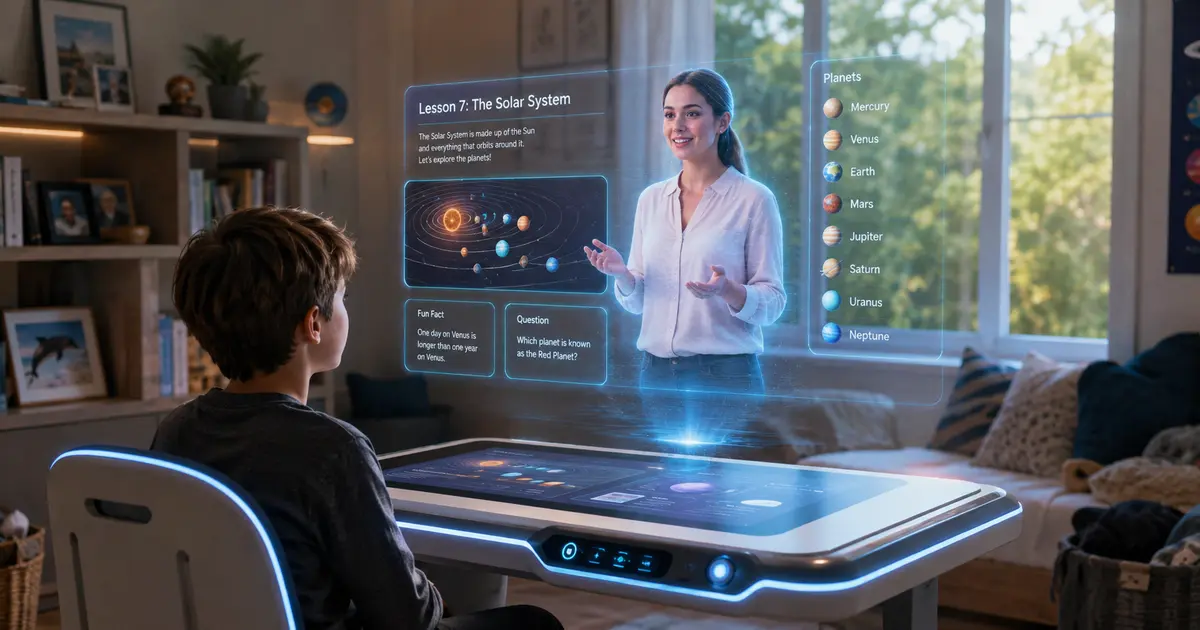
AI Homeschooling Future: Ultimate Guide to Hologram Teachers and Smart Desks
AI homeschooling is no longer just a dream for the future. For millions of families across the United States, it is quickly becoming the most exciting shift in how children learn at home. Imagine a morning where your child sits down, and instead of opening a textbook, a hologram teacher appears right in front of them — ready to teach, adapt, and engage in ways no printed page ever could.
This is not science fiction. It is the direction education technology is heading right now, and homeschool families are going to be the first ones to benefit from it.
AI Homeschooling With Hologram Teachers: Learning That Feels Like Magic
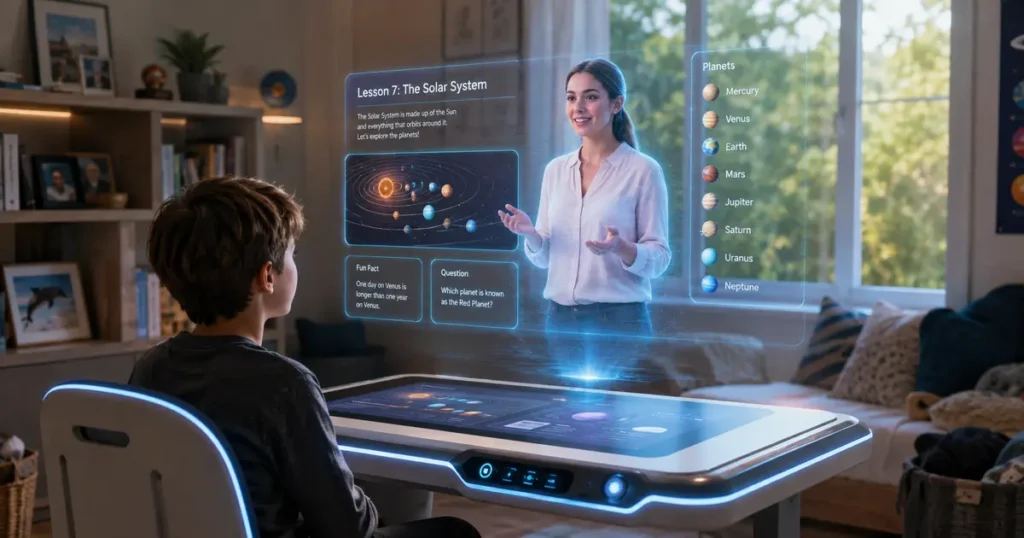
The idea of a hologram teacher sounds like something out of a Star Wars movie. But companies like Microsoft, Google, and dozens of education startups are already testing mixed reality learning environments where AI characters interact with students in three dimensions.
For homeschoolers, this changes everything.
Right now, one of the biggest concerns parents have about AI homeschooling is whether they can personally teach every subject well. Math, science, history, foreign languages — most parents are strong in some areas and weaker in others. An AI hologram teacher does not have that problem. It knows every subject at every grade level, speaks in a calm and patient tone, and never gets frustrated when your child asks the same question fifteen times.
More importantly, these AI teachers will change their teaching style based on how your child responds. If your daughter learns better through stories, the AI tells a story. If your son needs to see a diagram, the AI draws one right in front of him in 3D. If a child is bored, the AI senses it and switches the approach entirely.
Traditional classrooms with 25 students simply cannot offer this. AI homeschooling can.
Smart Desks That Make AI Homeschooling More Effective
Here is something most parents do not think about: a child’s ability to learn changes by the hour. A child who is energetic and focused at 9 AM might be completely checked out by 11 AM. Forcing the same lesson schedule every single day ignores how children actually work.
Smart homeschool desks of the future will fix this problem. These desks will use sensors to track small things — how often a child shifts in their seat, how quickly they’re answering questions, whether their eyes are focused or wandering. The desk’s built-in AI will process all of this data in real time and adjust the lesson accordingly.
If a child is clearly tired, the system might suggest a five-minute movement break. If a child is flying through material, it will automatically increase the difficulty so they stay challenged without getting bored. Think of it like a personal coach who is always watching, always adjusting, and always working toward one goal: helping your specific child learn at their personal best.
According to EdSurge, adaptive learning platforms are already showing strong results in personalized education settings, and the smart desk is simply the next physical step in that direction.
Daily AI Progress Reports: What Every AI Homeschooling Parent Needs
One of the hardest parts of homeschooling is knowing whether your child is actually making progress. Grades help, but they do not tell the whole story. A child might score well on a test but still have gaps in understanding. Another child might struggle on tests but actually grasp concepts deeply.
Future AI homeschooling systems will give parents a full picture every single day. Imagine getting a simple report on your phone each evening that tells you exactly what your child worked on, which parts they understood easily, where they got stuck, and what the AI plans to focus on tomorrow.
Not a vague letter grade — a real, detailed breakdown written in plain English that any parent can understand. These reports will also flag things that need your attention. If your child has struggled with the same math concept for five days in a row, the AI will not just keep repeating the same lesson. It will tell you, suggest a different approach, and even recommend resources you can use to help in a more hands-on way.
This kind of visibility is something even the best traditional schools cannot offer. Most parents get a report card four times a year. AI homeschooling will give you a full update every single day, without any extra work on your part.
How AI Homeschooling Turns Boring Homework Into Fun Games
Ask any parent what the hardest part of the school day is, and most will say homework. We covered this in detail in our post on the best math homework help tools for homeschool kids. Kids are tired, they resist sitting down, and arguments break out over worksheets that feel completely pointless to a ten-year-old.
The future of AI homeschooling replaces homework with something children actually want to do. Instead of filling out a worksheet on the American Revolution, your child might play an interactive game where they are a colonial leader making real decisions. The AI tracks every choice they make and uses it to evaluate their understanding of the historical events, cause and effect relationships, and the key figures involved. Your child thinks they are playing. The AI knows they are learning.
Research from the University of Colorado found that game-based learning improves both retention and motivation compared to traditional methods. When you add AI to the mix — AI that customizes the game to your child’s specific weak spots — the results get even better.
What AI Homeschooling Means for Parents Right Now
Some parents worry that AI will make homeschooling feel less personal. That is the opposite of what will actually happen.
Today, homeschool parents wear too many hats. You are the teacher, the curriculum planner, the grader, the motivator, and the administrator all at once. It is exhausting, and it leaves very little time for the part of homeschooling that actually matters most — the connection between parent and child.
When AI homeschooling takes over the heavy lifting — lesson delivery, progress tracking, content adjustment — parents are freed up to do the things AI cannot do. You can go deeper on topics your child is passionate about. You can take field trips without worrying about falling behind. You can have real conversations about what your child is learning instead of spending your energy managing the logistics of the school day.
AI does not replace the homeschool parent. It makes the homeschool parent more powerful. In fact, many families are already using AI to build smarter daily routines — see how in our guide on creating the perfect homeschool schedule with AI.
Is AI Homeschooling Already Happening?
You might be surprised to know that many pieces of this future are already here today. Platforms like Khan Academy’s Khanmigo, Synthesis, and IXL already use AI to personalize lessons for individual students. Tools like Duolingo have proven for years that AI can teach a language more effectively than a classroom because it adapts to the individual learner every single session.
What does not exist yet — but is coming — is the full integration of these tools into one seamless AI homeschooling system. Right now, homeschool families use five different apps, three different curricula, and a whiteboard in the kitchen. The future brings all of that together into one intelligent system that knows your child as well as you do.
According to Education Week, AI-powered personalized learning is one of the fastest-growing areas in education technology today, with hundreds of millions of dollars being invested into these tools every year.
Real Concerns Parents Have About AI Homeschooling
It would not be fair to only talk about the exciting parts. There are real questions that homeschool parents should think about.
Screen time: Will AI homeschooling mean children are staring at screens all day? The best AI learning systems will mix screen-based learning with physical activities, hands-on projects, and outdoor time. The goal is to make structured learning time more effective so children have more time for everything else.
Data privacy: These systems will collect a lot of information about your child. Parents will need to pay close attention to how companies handle that data. As AI in education grows, so will the laws around student data privacy. This is something to watch closely and advocate for.
Social skills: AI homeschooling does not automatically fix the social component. Parents will still need to be intentional about co-ops, sports teams, community involvement, and friendships. That part does not change.
Cost: Right now, AI learning tools range from free to a few hundred dollars per year. As the technology becomes more sophisticated, costs will rise before they come down. Expect a range of options at different price points, similar to how curriculum works today.
Why Homeschool Families Are Perfectly Positioned for AI Homeschooling
Traditional schools are going to struggle to adopt this technology quickly. They have large buildings, set schedules, standardized testing requirements, and thousands of moving parts. Change in public schools happens slowly.
Homeschool families have none of those limitations. A homeschool parent can try a new AI tool this week. If it works, keep it. If it does not, drop it and try something else. That kind of flexibility is exactly what the fast-moving world of AI homeschooling requires.
Families who are already homeschooling today are building the skills, habits, and mindset that will make AI-powered learning work for their children. You are not behind the curve. You are ahead of it.
What You Can Do Right Now to Get Ready for AI Homeschooling
- Try one AI learning tool this month. Khan Academy’s Khanmigo, Synthesis, or Reading Eggs for younger children can give you a real feel for how AI homeschooling adapts to your child’s learning style. Start small and see what works.
- Build good screen habits now. Balance screen-based learning with physical activity, creative play, and time outdoors. Healthy habits today make AI homeschooling more sustainable tomorrow.
- Stay informed. The AI education space is moving fast. Follow blogs like this one, join homeschool communities that discuss tech tools, and stay curious about what is coming.
- Keep the relationship central. Whatever tools you use, the most important part of homeschooling will always be the relationship between you and your child. AI can support that relationship. It cannot replace it.
Final Thoughts on the Future of AI Homeschooling
The future of AI homeschooling is not about replacing parents or turning children into robots who sit in front of screens all day. It is about giving every child the kind of personalized, engaging, and effective education that used to be available only to the very wealthy — and making it accessible to any family willing to homeschool.
Hologram teachers will make expert instruction available in every home. Smart desks will ensure learning happens at the right pace for each child. Daily AI reports will keep parents informed without overwhelming them. And interactive games will make the work of learning feel less like work.
Would you want to try AI homeschooling for your family? Drop your thoughts in the comments below — we would love to hear how you are already using AI tools in your homeschool today.
Views: 1


![How to Make the Best Homeschool Schedule with AI: A Full Weekly Planning Guide [2026]](https://theaihomeschooler.com/wp-content/uploads/2026/04/Create-a-Homeschool-Schedule-with-AI-768x403.webp "How to Make the Best Homeschool Schedule with AI: A Full Weekly Planning Guide [2026]")