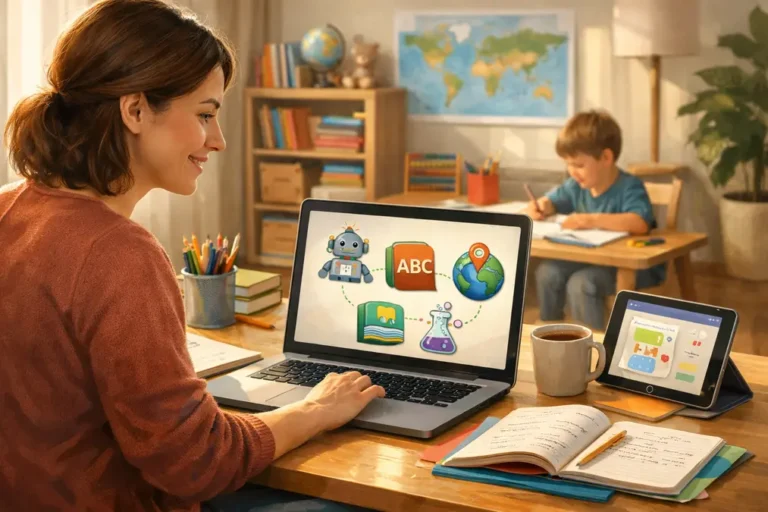

The Ultimate Guide on How to Use ChatGPT for Homeschooling: 7 Clever Ideas

Homeschooling your children is an incredibly rewarding journey, but let’s be honest—it can also be exhausting.
Between lesson planning, grading, and keeping kids engaged, parent-educators wear countless hats.
Fortunately, AI education tools have arrived to lighten the load and transform the modern classroom.
Wondering exactly how to use ChatGPT for homeschooling?
You can leverage this powerful AI tool to generate customized lesson plans, simplify complex topics, create engaging quizzes, grade assignments, and brainstorm creative science projects.
By acting as a specialized teaching assistant, it unlocks opportunities for true personalized learning, saving parents time while enriching the student’s educational experience.
Read on to discover seven actionable, time-saving ways to integrate AI into your daily homeschool routine.
How to Use ChatGPT for Homeschooling
- Idea 1: Build Custom Lesson Plans in Minutes
- Idea 2: Simplify Complex Subjects for Different Grade Levels
- Idea 3: Turn ChatGPT into an Interactive Socratic Tutor
- Idea 4: Generate Creative Writing and Homeschool Prompts
- Idea 5: Automate Grading and Provide Constructive Feedback
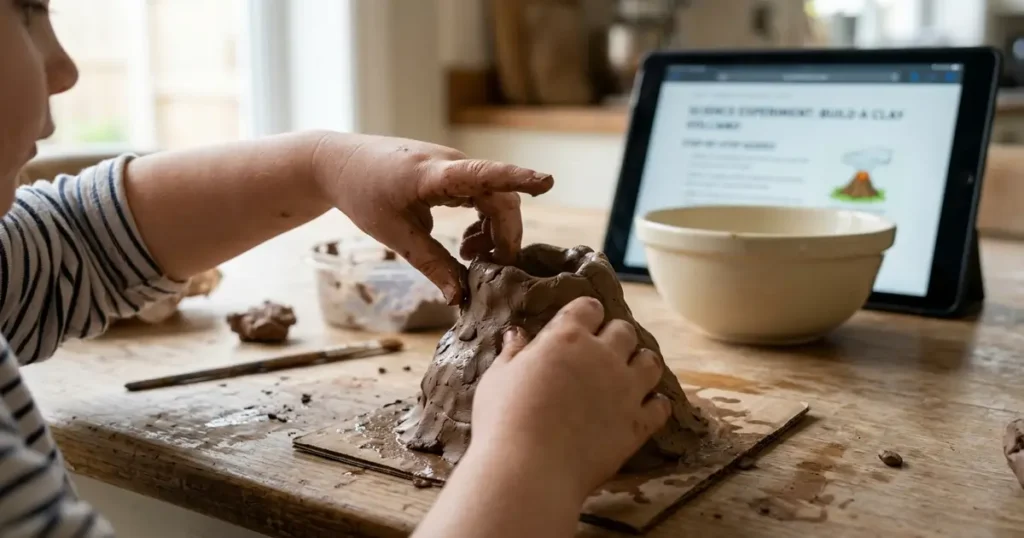
- Idea 6: Brainstorm Hands-On STEM Projects
- Idea 7: Tailor AI Education Tools for Special Needs
Idea 1: Build Custom Lesson Plans in Minutes
Creating a homeschool curriculum from scratch takes hours of intensive research.
Fortunately, integrating AI education tools into your planning process can slash that time to mere minutes.
You can ask ChatGPT to map out daily, weekly, or monthly schedules based on your child’s specific grade level, learning pace, and personal interests. It effectively acts as your personal curriculum coordinator, giving you more time to focus on hands-on teaching.
Try this prompt:
“Create a 5-day lesson plan for a 4th grader covering the solar system. Include one hands-on activity per day, a vocabulary list, and a short Friday quiz.”
The Result:
- Day-by-day structure: No more guessing what to teach on Tuesday morning.
- Resource lists: Instant ideas for books, documentaries, and educational videos.
- Time management: Clear, actionable time blocks designed for each subject.
Idea 2: Simplify Complex Subjects for Different Grade Levels
Every homeschool parent eventually hits a subject they struggle to teach.
Whether it is algebraic fractions, cellular biology, or classical literature, AI can quickly break it down into understandable pieces.
ChatGPT excels at simplifying high-level concepts into bite-sized, age-appropriate explanations.
This ensures your child actually grasps the material fundamentally rather than just relying on rote memorization.
Actionable Steps:
1. Use the ELI5 Method: Type, “Explain [complex topic] to me like I am 5 years old.”
2. Adjust the Tone: Ask the AI to explain the water cycle in the style of a pirate or a superhero to instantly boost engagement.
3. Generate Analogies: Ask for real-world analogies to make abstract math or science concepts tangible.
Idea 3: Turn ChatGPT into an Interactive Socratic Tutor
One of the most powerful ways to learn is through the Socratic method-asking questions to stimulate critical thinking and illuminate ideas.
You can elevate personalized learning by turning ChatGPT into an interactive, conversational tutor. Instead of just giving the student the direct answer, the chatbot can guide them to find it themselves through targeted homeschool prompts.
Try this prompt:
“Act as a Socratic tutor. My 8th grader is learning about the American Revolution. Ask them one question at a time to test their knowledge, and wait for their response before replying.”

Idea 4: Generate Creative Writing and Homeschool Prompts
Staring at a blank page is intimidating for young writers.
Combating writer’s block is a constant, frustrating battle in the homeschool classroom.
ChatGPT is a master at generating highly tailored homeschool prompts and story starters.
You can effortlessly align these prompts with your child’s current hyper-fixations, whether that is dinosaurs, space travel, or fantasy dragons.
Creative Writing Hacks:
- Choose-Your-Own-Adventure: Have your child write the first paragraph of a story, and let ChatGPT generate three exciting options for what happens next.
- Debate Prep: Ask the AI to argue the opposing side of a persuasive essay your high schooler is currently drafting.
- Vocabulary Integration: Instruct the AI to generate a story prompt that *must creatively include five specific spelling words.
Idea 5: Automate Grading and Provide Constructive Feedback
Grading essays and checking complex math steps is a major time-drain.
By letting AI assist with your daily workflow, you can automate this tedious administrative process.
While you should always personally review the AI’s feedback, it provides an excellent first pass.
It can instantly spot grammatical errors, check historical facts, and even suggest advanced structural improvements.
💡 Pro Tip: Expert Insights on AI Grading
According to educational experts at Forbes, AI in education isn’t about replacing the teacher, but augmenting them.
When using AI to grade, always ask it to provide a feedback sandwich-praising what the student did well before offering constructive, gentle criticism.
Try this prompt:
“Act as an English teacher. Review this 6th-grade essay on climate change. Grade it based on a 1-10 scale for grammar, structure, and argument. Provide gentle, encouraging feedback using the feedback sandwich method.”
Idea 6: Brainstorm Hands-On STEM Projects
Homeschooling thrives on experiential, hands-on learning.
However, coming up with fresh, affordable science experiments week after week can be challenging.
ChatGPT can generate endless lists of STEM projects using everyday items you already have lying around your house, keeping your curriculum exciting and budget-friendly.
How to get the best results:
- List your available household supplies (e.g., baking soda, vinegar, cardboard, rubber bands).
- Ask ChatGPT to create an engineering challenge using only those listed items.
- Request a step-by-step hypothesis worksheet to accompany the physical project.
Idea 7: Tailor AI Education Tools for Special Needs
Every child learns differently. In the United States, homeschooling is incredibly popular for families of neurodivergent children who are seeking a highly tailored environment.
You can easily adapt AI education tools to champion personalized learning, perfectly supporting children with ADHD, autism, or dyslexia. AI can rapidly reformat text to make it much more accessible and digestible for your child’s specific learning style.
Accommodation Strategies:
- Micro-Learning: Ask ChatGPT to break a long, overwhelming reading assignment into five short, bulleted summaries.
- Visual Prompts: Have the AI write highly descriptive image prompts. You can plug these into an AI image generator to provide immediate visual aids for visual learners.
- Executive Dysfunction: Use the AI to generate step-by-step checklists for daily chores and school tasks to help children stay organized and focused.
Frequently Asked Questions (FAQ)
Is ChatGPT safe for kids to use directly?
While ChatGPT is a powerful tool, it is generally recommended for parents to act as the intermediary for younger children. OpenAI requires users to be at least 13 years old. Always monitor your teenager’s usage to ensure safe and productive interactions.
Can ChatGPT replace a traditional homeschool curriculum?
No, AI should not entirely replace a structured, state-approved curriculum. Instead, consider ChatGPT as a highly capable teaching assistant that supplements and enhances your core educational materials.
Does ChatGPT give accurate historical and mathematical facts?
ChatGPT is highly intelligent but can occasionally “hallucinate” or provide incorrect information. Parent-educators should always fact-check the AI’s output, especially regarding specific historical dates or advanced mathematical formulas.
What is the best way to start using AI in my homeschool routine?
Start small. Use AI to generate a single reading quiz or brainstorm one science project this week.
As you get comfortable using homeschool prompts, you can slowly integrate the tool into your daily lesson planning and grading workflow.
Conclusion
Embracing artificial intelligence doesn’t mean you are handing your child’s education over to a robot.
Instead, mastering how to use ChatGPT for homeschooling empowers you to be a more efficient, creative, and relaxed educator.
From whipping up instant lesson plans to acting as a tireless Socratic tutor, ChatGPT is the ultimate companion for the modern homeschool family.
By taking the heavy lifting out of administrative tasks, you get to focus on what truly matters: spending quality time learning alongside your child.
Ready to transform your homeschool routine? Open up ChatGPT today, copy one of the homeschool prompts from this article, and watch the magic happen!
4 More Clever Ways to Use ChatGPT for Homeschooling
8. Generate a Full Year Scope and Sequence
One of the most time-consuming tasks in homeschooling is planning what to teach and when. ChatGPT can generate a complete scope and sequence for any subject in minutes. Try: “Create a 36-week scope and sequence for 6th grade science covering life science, earth science, and physical science. Include one hands-on project per unit and suggest assessments.” Review and adjust the output, then you have your year planned.
9. Create Interest-Led Unit Studies
ChatGPT excels at connecting your child’s interests to academic content. If your child is obsessed with Minecraft, dinosaurs, or cooking, ChatGPT can build a full unit study around that interest covering multiple subjects simultaneously. Try: “Create a 2-week unit study for a 4th grader interested in space exploration. Connect it to math (distances, scales), writing (journal entries from an astronaut), science (planets, gravity), and history (space race). Include one activity per subject per week.”
10. Differentiate for Multiple Children
If you are teaching multiple children on the same topic but at different levels, ChatGPT can generate differentiated versions of the same content simultaneously. Try: “I am teaching the American Revolution to a 4th grader and a 7th grader at the same time. Create two versions of a reading passage on the same topic — one at 4th grade level and one at 7th grade level. Then give me five discussion questions that work for both age groups.”
11. Build a Socratic Discussion
For older homeschool students, ChatGPT can facilitate Socratic seminars — structured academic discussions that build critical thinking. Try: “Run a Socratic discussion with me about the ethical implications of AI in education. Ask me one question at a time. After each answer, ask a follow-up question that pushes my thinking further.” This is an exceptionally effective tool for high school students developing argumentative reasoning skills.
Pairing ChatGPT With Other AI Tools
ChatGPT is most powerful as part of a toolkit rather than as a standalone tool. Here is how it pairs with the other top homeschool AI tools:
- ChatGPT + MagicSchool AI: MagicSchool generates standard lesson plans. ChatGPT generates custom content when you need something more specific — a worksheet on an unusual topic, a story prompt tied to a specific interest, or a quiz on exactly the content covered this week.
- ChatGPT + StarSpark AI: StarSpark handles adaptive math practice automatically. ChatGPT handles everything else — science explanations, writing feedback, history discussion questions, vocabulary practice. Together, they cover all subjects with minimal parent prep time.
- ChatGPT + Grammarly: Grammarly catches mechanical errors in student writing. ChatGPT provides content and argument feedback. Use both on every substantial piece of writing.
Try StarSpark AI — Pairs Perfectly With ChatGPT for a Complete Homeschool Toolkit
Related: Best AI tools for homeschool parents and free AI lesson planners guide.
Views: 0